
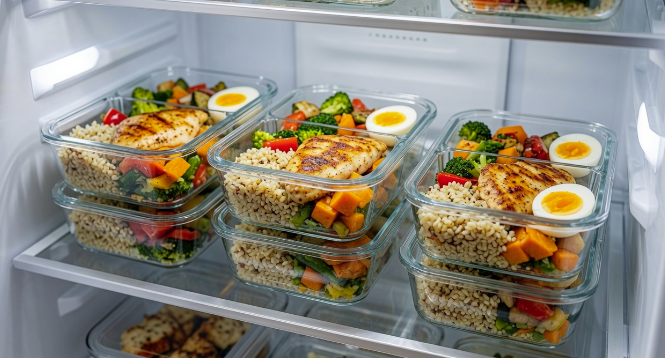
Meal prep does not have to mean spending your entire Sunday cooking seven identical meals.
For beginners, that approach is often exactly why meal prep fails.
You prepare too much food, get tired of eating the same thing, discover that some meals do not reheat well, and eventually go back to deciding what to eat at the last minute.
A better system is simpler:
Prepare enough food in advance to make your busiest meals easy—but leave enough flexibility that you still want to eat it.
That might mean cooking complete meals.
Or it might mean preparing chicken, rice, vegetables and a few sauces separately so you can turn the same ingredients into different meals throughout the week.
This guide shows you how to build a meal-prep system that saves time, reduces food waste and makes balanced meals easier without turning food into another complicated project.
HQ Quick Trick: Do not start by prepping seven days of food. Start by making your next three busy meals easier.
What Meal Prep Actually Means
Meal prep simply means doing part of your future cooking in advance.
There are three useful ways to do it.
Complete Meal Prep
You cook and portion entire meals in advance.
For example:
- Chicken, rice and vegetables
- Chili with whole-grain bread
- Pasta with vegetables and protein
- Lentil curry with rice
This is convenient when you know exactly when and where you will eat.
Component Prep
Instead of assembling finished meals, you prepare ingredients separately.
For example:
- Cooked chicken
- Rice or another grain
- Roasted vegetables
- Washed salad greens
- A sauce or dressing
During the week, those ingredients can become several different meals.
This approach usually provides more variety than eating identical containers every day.
Friction-Removal Prep
This is the easiest form of meal prep and one of the most underrated.
You prepare the annoying parts of cooking without actually cooking every meal.
Examples include:
- Washing vegetables
- Chopping onions
- Portioning snacks
- Preparing overnight oats
- Making a dressing
- Marinating protein
- Cooking one batch of grains
If full meal prep feels overwhelming, start here.
The Best Meal-Prep System for Beginners
The goal is not to prepare the maximum amount of food.
The goal is to eliminate the moments when being tired or busy makes eating well unnecessarily difficult.
Use this five-step system.
Step 1: Find Your Problem Meals
Do not begin by planning breakfast, lunch, dinner and snacks for an entire week.
Ask instead:
Which meals usually go wrong?
Maybe breakfast is already easy but lunch at work becomes takeout.
Maybe lunch is fine but you arrive home tired and order dinner.
Start with those meals.
For many beginners, preparing only three lunches or three dinners is enough to make a noticeable difference.
HQ Quick Trick: Prep the meals where convenience normally beats your intentions.
Step 2: Choose Two Meals, Not Seven
Pick two meals you genuinely enjoy.
They should ideally share some ingredients.
For example:
Meal A
Chicken rice bowl with vegetables and yogurt-based sauce.
Meal B
Chicken wrap with vegetables, salad and the same sauce.
One batch of chicken and vegetables creates two meals that feel different.
This reduces:
- Cooking time
- Grocery complexity
- Food waste
- Meal boredom
You can use the same idea with beans, lentils, tofu, fish, eggs or other proteins you enjoy.
Step 3: Build Meals From Flexible Components
Instead of memorizing complicated meal-prep recipes, use a simple framework.
A practical meal can include:
Protein + vegetables or fruit + a grain or other carbohydrate + flavor
For example:
| Component | Examples |
|---|---|
| Protein | Chicken, fish, eggs, beans, lentils, tofu, yogurt |
| Vegetables | Broccoli, peppers, carrots, spinach, tomatoes |
| Carbohydrate | Rice, potatoes, oats, pasta, whole grains |
| Flavor | Salsa, herbs, spices, yogurt sauce, pesto, dressing |
This is deliberately flexible.
Healthy eating is about your overall pattern, not whether every container follows a perfect mathematical ratio.
USDA’s MyPlate guidance similarly emphasizes variety across vegetables, fruits, grains and protein foods rather than one rigid menu.
Step 4: Make One Shopping List From the Plan
Once you know your meals, create the shopping list.
Check your refrigerator, freezer and cupboards first.
Then organize your list into categories:
- Protein
- Vegetables and fruit
- Grains and starches
- Dairy or alternatives
- Sauces and seasonings
- Snacks
- Storage supplies if needed
This sounds obvious, but it solves one of the biggest meal-prep mistakes:
Buying aspirational groceries with no actual plan for using them.
If you cannot say which meal an ingredient belongs to, think twice before adding it to the cart.
Step 5: Prep in the Right Order
Do not cook one entire recipe from beginning to end and then start the next one.
Overlap tasks.
A simple workflow might look like this:
Start the Slowest Item
Put rice, potatoes or another longer-cooking component on first.
Start Oven Items
Roast vegetables or proteins while other tasks continue.
Use Waiting Time
While food cooks:
- Wash produce
- Chop vegetables
- Mix sauces
- Portion snacks
- Prepare containers
Assemble Last
Once cooked food is ready and safely handled, combine or store components according to how you plan to use them.
This turns meal prep into one coordinated cooking session instead of several recipes performed one after another.
The Three-Meal Starter System
If you have never meal-prepped before, try this before doing anything more ambitious.
Prepare:
One protein
Example: chicken, lentils or tofu.
One carbohydrate base
Example: rice, potatoes or whole grains.
Two vegetables
Choose vegetables that store and reheat well.
One sauce
This is what prevents the meals from feeling identical.
From those ingredients you can create:
Meal 1
Grain bowl.
Meal 2
Wrap or pita.
Meal 3
Salad or mixed bowl.
Same shopping trip.
Same core ingredients.
Different eating experience.
Sauces Are the Easiest Way to Prevent Meal-Prep Boredom
The basic ingredients do not always need to change.
The flavor does.
Imagine chicken, rice and roasted vegetables.
One day add salsa.
Another day use a yogurt-herb sauce.
Another day add a different dressing or spice mixture.
Suddenly the same ingredients no longer feel like the same meal.
Store sauces separately when possible so food does not become soggy.
Do You Need Meal-Prep Containers?
Not necessarily.
If you already own safe containers with secure lids, use them.
You do not need to buy an enormous matching set just because you have started meal prepping.
Useful features include:
- Leak-resistant lids
- Microwave compatibility when appropriate
- Freezer compatibility when needed
- Easy cleaning
- Stackable shape
- Sizes that match your meals
Glass is convenient for reheating and does not retain odors easily.
Lightweight food-safe plastic can be more practical when carrying meals to work.
Neither material automatically makes you better at meal prep.
The system matters more than the container.
Food Safety Is Part of Meal Prep
Preparing several meals at once means you also need a safe storage plan.
One of the biggest mistakes in meal-prep content online is treating refrigeration times as an afterthought.
They should influence how much food you prepare.
USDA guidance says most cooked leftovers should generally be refrigerated for three to four days.
That means cooking seven refrigerator meals on Sunday and assuming the final one will still be suitable the following Saturday is not a good default strategy.
For food you will eat later, freezing part of the batch is usually a better option.
Refrigerate Perishable Food Promptly
USDA and FDA guidance says perishable food should generally not remain at room temperature for more than two hours, or one hour when temperatures exceed 90°F / 32°C.
Use shallow containers when practical so hot food can cool more efficiently.
Keep the refrigerator at 40°F / 4°C or below.
Do not leave an entire afternoon’s meal prep sitting on the counter while you clean the kitchen.
Do Not Rely Only on Smell
Food can sometimes contain harmful bacteria without obviously looking or smelling spoiled.
Use safe storage times rather than using your nose as the only test.
Labeling containers with the preparation date makes this much easier.
Reheat Properly
USDA guidance recommends reheating leftovers to 165°F / 74°C.
A food thermometer removes the guesswork, particularly with dense dishes such as casseroles or large portions.
What Should You Freeze?
Freeze food when you know you will not eat it within the safe refrigerated storage period.
Foods that often freeze reasonably well include:
- Soups
- Stews
- Chili
- Cooked grains
- Many curries
- Cooked beans and lentils
- Some cooked meats
- Sauces
Texture can change after freezing, so experiment rather than freezing huge quantities the first time you make something.
Items with delicate fresh vegetables or certain dairy-heavy sauces may be better assembled later.
The “Cook Once, Finish Later” Method
You do not need to cook every component completely in advance.
Sometimes the best prep is preparing ingredients so dinner takes ten minutes instead of forty.
For example:
Earlier
- Chop vegetables
- Prepare sauce
- Marinate protein
- Cook rice
At Dinner
Cook the protein fresh and reheat the remaining components.
You still save most of the work while keeping the meal closer to freshly cooked.
This method is particularly useful for people who dislike reheated food.
Meal Prep for Work
Lunch is often the easiest meal to prep because the alternative is frequently expensive convenience food.
Build office lunches around foods that:
- Travel well
- Do not leak
- Reheat easily
- Still taste good after refrigeration
A practical lunch could include:
- Protein
- Grain or potato
- Vegetables
- Fruit
- Sauce stored separately
If you do not have access to a refrigerator, you need an insulated lunch bag and adequate cold packs for foods requiring refrigeration.
Food safety does not stop when the container leaves your kitchen.
Meal Prep When You Work From Home
Working from home does not automatically make healthy eating easier.
The refrigerator is nearby, but so is work.
A useful strategy is ingredient prep rather than complete meal prep.
Prepare items such as:
- Cooked grains
- Washed vegetables
- Ready protein
- Soup
- Fruit
- Simple sauces
Then assemble lunch in a few minutes.
This preserves flexibility while preventing a busy workday from turning lunch into whatever snack happens to be nearest.
Meal Prep for Exercise
If you exercise regularly, meal prep can make it easier to have normal balanced meals available around your training schedule.
You do not need a bodybuilding-style collection of identical chicken-and-rice containers.
Focus on adequate overall nutrition and meals that fit your appetite and routine.
If you are beginning exercise at home, our home workout routine for beginners provides a simple training structure you can coordinate with your meal routine.
For individual medical or sports-nutrition requirements, personalized advice from a qualified health professional is more useful than a generic online meal plan.
Meal Prep and Intermittent Fasting
Meal prep and meal timing are separate ideas.
You can meal prep whether you:
- Eat breakfast
- Skip breakfast
- Eat three meals
- Use a time-restricted eating pattern
If you already practice intermittent fasting, meal prep can simply make the meals inside your eating window easier to plan.
Do not start fasting just because you started meal prepping.
If you are considering it separately, our intermittent fasting guide for beginners explains what the approach does, where the evidence is stronger, and when it may not be suitable.
The Grocery Overlap Trick
One of the easiest ways to cut both preparation time and wasted food is to intentionally reuse ingredients.
Imagine buying:
- Chicken
- Bell peppers
- Tomatoes
- Lettuce
- Rice
- Tortillas
- Yogurt
Those ingredients could become:
Bowl
Chicken + rice + vegetables + yogurt sauce.
Wrap
Chicken + vegetables + tortilla + sauce.
Salad
Chicken + lettuce + tomatoes + vegetables.
You are not eating exactly the same meal three times.
But you are also not buying ingredients for three completely unrelated recipes.
Use Frozen Vegetables Without Guilt
Frozen vegetables are useful meal-prep ingredients.
They are already washed and prepared, last much longer than fresh produce, and can reduce the amount of food thrown away.
Fresh is not automatically superior for every situation.
Choose whichever format makes it more likely that the food will actually be eaten.
The same logic applies to canned beans, canned tomatoes and other convenient staple foods.
Convenience can support healthy eating rather than oppose it.
Keep a “Backup Meal” in the Freezer
Even a good meal-prep system occasionally fails.
Meetings run late.
Plans change.
Food gets eaten sooner than expected.
Instead of aiming for perfect planning, keep one or two easy freezer meals available.
That creates a useful middle option between cooking from scratch and ordering takeout.
The backup does not have to be homemade.
A convenient commercial meal that fits your needs can still perform the job.
How Meal Prep Can Reduce Food Waste
Meal prep can save money only when you actually eat what you prepare.
To reduce waste:
Shop From Your Kitchen First
Check what needs using before choosing meals.
Use Perishable Ingredients Early
Plan meals containing delicate vegetables or fresh fish earlier in the cycle.
Freeze Extras
Do not wait until food is nearly at the end of its refrigerator life before deciding you cannot eat it.
Reuse Ingredients
Choose meals with overlapping groceries.
Prepare Less
This is the most overlooked solution.
If you repeatedly throw away the final two meals, stop preparing them.
Meal prep should adapt to your behavior rather than forcing you to eat according to a plan you dislike.
Do Not Turn Meal Prep Into a Diet
Meal prep is an organizational tool.
It is not inherently:
- Low calorie
- High protein
- Low carbohydrate
- Vegan
- Keto
- Weight-loss focused
You can use meal prep with many different eating patterns.
Avoid automatically copying a meal plan designed around someone else’s calorie target, body size or medical needs.
For most people, a better starting point is simply increasing the availability of varied, nutrient-dense foods that they already enjoy.
The Biggest Meal-Prep Mistakes
Preparing Too Much Food
Start with two or three days.
Increase only when you consistently eat what you prepare.
Choosing Recipes You Would Not Normally Eat
Meal prep will not magically make you enjoy food you already dislike.
Using Too Many Recipes
Five unrelated recipes mean more ingredients, more cooking and more cleanup.
Ignoring Texture
Some foods taste significantly worse after several days in the refrigerator.
Keep crisp or wet components separate where appropriate.
Forgetting Food Safety
Meal-prep convenience never overrides safe storage.
Making Everything Identical
Use different sauces, formats or sides to introduce variety.
Trying to Be Perfect
Missing one prep session does not mean the system failed.
Prepare what you can and continue.
The 30-Minute Emergency Meal Prep
You do not always need a large cooking session.
If your week becomes unexpectedly busy, use this stripped-down version.
Prepare:
- One quick protein or protein-rich option
- One easy carbohydrate
- One or two vegetables
- Fruit
- One sauce
Examples:
Option 1
Eggs + whole-grain bread + washed vegetables + fruit.
Option 2
Canned beans + microwavable rice + frozen vegetables + salsa.
Option 3
Rotisserie chicken + potatoes + bagged salad.
The goal is not culinary perfection.
It is having a better default available when time disappears.
A Simple Weekly Workflow
A sustainable meal-prep routine can look like this:
Before Shopping
Check your kitchen and identify food that needs using.
Choose Your Problem Meals
Pick two or three meals where preparation will help most.
Pick Two Flexible Recipes
Prefer meals with overlapping ingredients.
Shop
Buy only what the plan requires plus your normal staples.
Prep
Cook the longest components first and overlap tasks.
Store Safely
Refrigerate what you will eat soon and freeze later portions.
Midweek Check
Look at what remains before buying or cooking more.
This final step prevents the classic problem of preparing new food while old food is still waiting in the refrigerator.
The HQTrick Two-Week Starter Plan
Do not try to optimize everything immediately.
Week 1: Prep Three Meals
Learn:
- How much food you actually eat
- Which containers work
- What reheats well
- How much preparation time feels reasonable
Week 2: Fix One Problem
Maybe:
- The meals became boring.
- Vegetables became soggy.
- Portions were too large.
- You prepared too much.
- Cooking took too long.
Change only that problem.
Within a few cycles you will have a system designed around your own routine instead of copying someone else’s Instagram refrigerator.
Frequently Asked Questions
How do I start meal prepping as a beginner?
Start with the two or three meals during the week that are hardest for you to manage.
Choose simple recipes with overlapping ingredients, prepare a few portions and adjust the system based on what you actually eat.
How many days should I meal prep for?
For refrigerated cooked leftovers, USDA guidance generally recommends three to four days.
Freeze portions intended for later rather than automatically storing an entire week’s cooked meals in the refrigerator.
Is meal prep healthy?
Meal prep itself is neither healthy nor unhealthy.
It is simply a preparation method.
The nutritional quality depends on the food you choose.
Do I need to count calories when meal prepping?
No.
Meal prep can be used with or without calorie tracking.
People with specific medical, performance or weight-management needs may benefit from individualized guidance.
Can I meal prep with frozen vegetables?
Yes.
Frozen vegetables are convenient, store well and can help reduce preparation time and food waste.
Is meal prep good for saving money?
It can be, particularly when it reduces takeout and food waste.
But buying excessive ingredients or preparing food that goes uneaten can erase those savings.
Should I meal prep every meal?
No.
Prep only as much as makes your life easier.
For many people, preparing weekday lunches or a few dinners provides most of the benefit.
Can meal prep help with stress?
It can remove some daily meal decisions and cooking tasks.
But meal prep should simplify your routine rather than become another demanding weekly obligation.
If general stress is becoming a larger issue than meal planning, our guide to evidence-based stress and anxiety techniques covers that topic separately.
Final Verdict
The best meal prep for beginners is not the system that produces the most containers.
It is the system you can repeat.
Start with the meals that cause the most friction.
Choose a few ingredients that can work in several ways.
Cook only as much as you are likely to eat.
Follow safe storage practices.
Freeze food you will not use soon.
And adjust the process every week until it fits your real schedule.
You do not need a perfect Sunday routine.
You need a refrigerator that makes the easiest choice a little better than it was yesterday.
The HQTrick rule: prep enough to make life easier—not enough to make meal prep itself feel like a second job.