
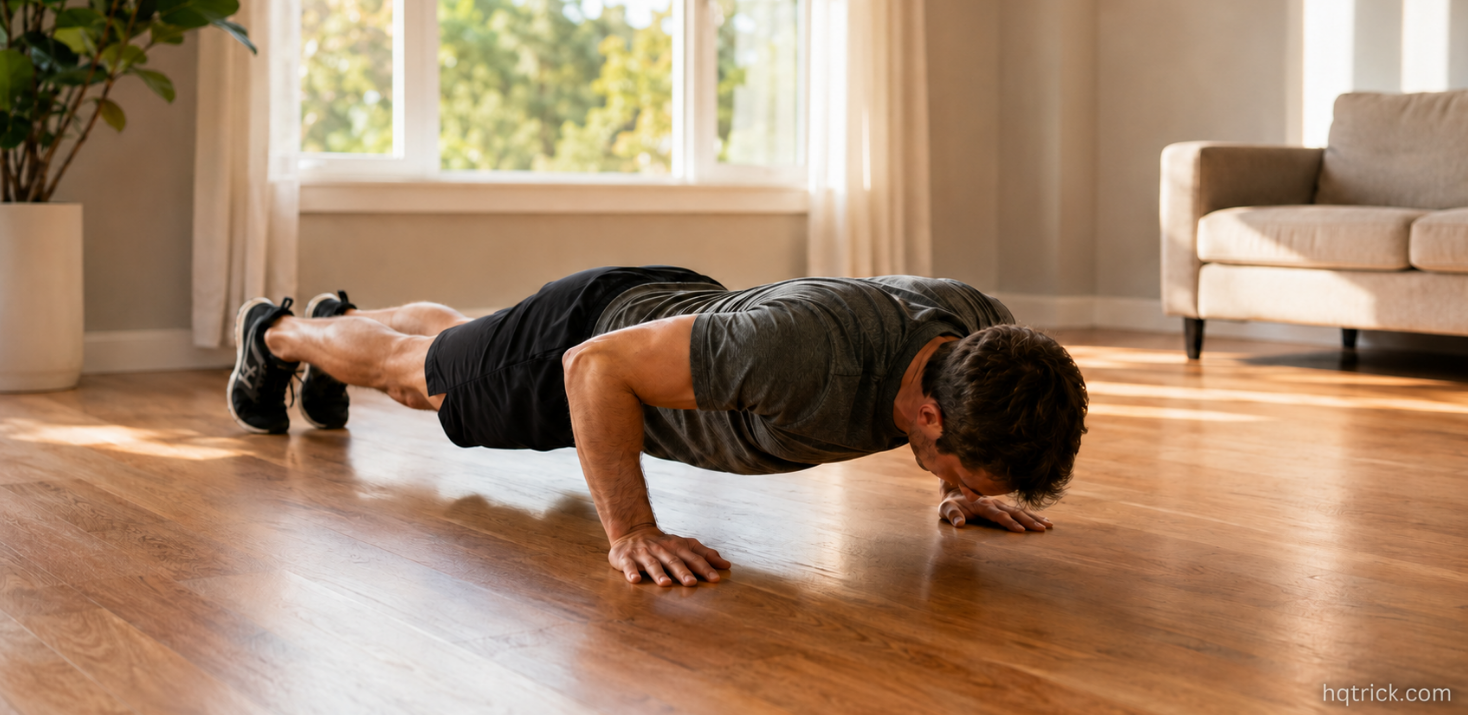
The Best Home Workout Routine for Beginners (No Equipment, No Gym)
The gym is one of the stranger rituals of modern life. You drive somewhere to use machines that simulate activities you could do anywhere — squatting, pushing, pulling, hinging — and pay a monthly fee for the privilege of doing it in a specific building, surrounded by other people doing the same thing.
This doesn’t mean gyms are bad. For many people they’re excellent. But for beginners especially, the gym creates a set of barriers — the cost, the travel, the self-consciousness of not knowing what you’re doing — that often prevent the workout from happening at all. A home workout that happens is worth more than a gym session that doesn’t.
This guide is a complete beginner program: eight weeks of progressive training, no equipment required, with the reasoning behind each decision explained so you understand what you’re doing and why.
What “Beginner” Actually Means
“Beginner” in fitness has a specific meaning: someone who has not been consistently training for the past six months. It doesn’t mean unfit, or overweight, or unable to do things. It means your body hasn’t adapted to systematic exercise stress yet — and that’s actually a significant advantage.
Beginners make faster progress than anyone else. A person with zero training history who follows a structured program for three months gains more strength and fitness than an advanced athlete training three years for the same duration. This is called “newbie gains” and it’s real. The key is capturing it with consistency rather than wasting it on disorganized effort.
The Four Movement Patterns That Cover Everything
Thousands of exercises exist. For a beginner, the vast majority of your progress comes from mastering four fundamental movement patterns. Every other exercise is a variation on these:
Push: Moving weight away from your body (push-up, overhead press). Develops chest, shoulders, triceps.
Pull: Moving weight toward your body (row, pull-up). Develops back, biceps, rear shoulders. This is the most underdeveloped pattern in most self-designed programs.
Squat: Lowering and raising your body with bent knees (squat, lunge). Develops quads, glutes, core.
Hinge: Bending at the hip with a neutral spine (glute bridge, deadlift). Develops hamstrings, glutes, lower back.
A balanced program trains all four patterns. An unbalanced program — all push, no pull, for example — creates muscular imbalances that eventually produce pain and injury.
The 8-Week Beginner Program
How to Read This Program
Each workout session takes 25–40 minutes. Three sessions per week is the schedule — Monday/Wednesday/Friday or any three non-consecutive days. Rest days are not optional accessories; muscle adaptation happens during recovery, not during the workout itself.
Each exercise includes a beginner modification and a progression when the standard version becomes manageable. Reps means repetitions. Sets means complete rounds of the exercise.
Progress principle: When you can complete all sets of an exercise with good form and feel like you could do 2–3 more reps at the end of the last set, move to the next progression or add one rep per set.
Weeks 1–2: Foundation
The goal in the first two weeks is establishing the habit and learning the movement patterns — not exhausting yourself. If you feel sore but not destroyed after these workouts, you’re calibrated correctly.
Workout A (Push + Squat focus)
Incline Push-Up — 3 sets of 8–10 reps Place hands on a counter or sturdy chair rather than the floor. This reduces the percentage of your bodyweight you’re pushing, making it achievable regardless of starting strength. As you get stronger, lower the surface — kitchen counter → coffee table → floor cushion → floor.
Bodyweight Squat — 3 sets of 10 reps Stand with feet slightly wider than hip-width, toes angled slightly out. Lower until thighs are parallel to the floor (or as low as is comfortable without your heels rising). Push through your whole foot to stand. If balance is an issue, hold a door frame lightly with one hand.
Glute Bridge — 3 sets of 12 reps Lie on your back with knees bent and feet flat on the floor, hip-width apart. Push your hips toward the ceiling by squeezing your glutes. Hold one second at the top. Lower controlled. This is the foundational hinge pattern.
Dead Bug — 3 sets of 8 reps per side Lie on your back, arms reaching toward the ceiling, knees bent at 90 degrees. Slowly lower your right arm and left leg toward the floor simultaneously, keeping your lower back pressed to the floor. Return and switch sides. This develops core stability in a way that directly transfers to every other exercise.
Rest 60–90 seconds between sets.
Workout B (Pull + Hinge focus)
Table Row (Inverted Row Modification) — 3 sets of 8 reps Lie under a sturdy table. Grip the edge with an overhand grip, body straight and heels on the floor. Pull your chest up to the table edge, then lower controlled. This is the most important beginner pulling exercise because it develops the muscles most people never train at home. The table row is harder than it looks.
Reverse Lunge — 3 sets of 8 reps per leg Stand, step one foot back, lower your back knee toward the floor while keeping your front shin vertical. Drive through your front heel to stand. The reverse lunge is easier to learn than the forward lunge and puts less stress on the knee.
Hip Hinge Deadlift Pattern (Bodyweight) — 3 sets of 12 reps Stand with feet hip-width apart. Push your hips backward (not down) while maintaining a flat back, lowering your hands toward the floor until you feel a stretch in your hamstrings. Drive hips forward to stand. This teaches the hinge pattern without any load — the foundation for every pulling exercise.
Plank — 3 sets of 20–30 seconds Forearms on the floor, body straight from head to heels. Don’t let your hips sag. If this is too difficult, do it from your knees.
Alternate between Workout A and Workout B across your three sessions each week.
Weeks 3–4: Building Volume
Same movements. More reps, or harder progressions.
- Push-up: move to the next lower surface, or attempt standard floor push-ups.
- Squat: add a 2-second pause at the bottom of each rep.
- Glute Bridge: progress to single-leg glute bridge — same movement with one foot raised.
- Table Row: elevate your feet on a chair to increase the percentage of bodyweight you’re rowing.
- Reverse Lunge: add a forward lean of the torso for increased glute activation.
- Plank: extend to 40–45 seconds per set.
Increase sets from 3 to 4 for exercises that feel manageable.
Weeks 5–6: Intensity
New exercises introduced:
Pike Push-Up (Shoulder Press Pattern) — replace incline push-up in Workout A Start in a downward dog position (hips high, body forming an inverted V). Bend your elbows to lower the top of your head toward the floor, then press back up. This shifts emphasis to the shoulders.
Bulgarian Split Squat — replace reverse lunge in Workout B Stand two feet in front of a couch or chair. Place one foot behind you on the surface. Lower your back knee toward the floor, front shin vertical. This single-leg exercise is significantly harder than a regular lunge and produces serious leg development.
Tempo Push-Up — add to Workout A Standard push-up with a 3-second lowering phase, 1-second pause at the bottom, and explosive push back up. Tempo training increases time under tension without adding reps.
Weeks 7–8: Progression Decisions
By week seven, you should be able to do standard floor push-ups for multiple sets of 10–12 reps, hold a plank for over a minute, and feel the workouts as challenging but not crushing.
At this point, three paths forward:
Path 1: Continue bodyweight training with harder progressions. The bodyweight training world is deep — pike push-ups lead to handstand push-up progressions, squats lead to single-leg squats (pistol squats), rows lead to pull-ups. You can build serious fitness without equipment.
Path 2: Add minimal equipment for new stimulus. A $30 set of resistance bands unlocks dozens of exercises that bodyweight can’t replicate efficiently (bicep curls, face pulls, lat pulldowns). A $15 set of light dumbbells extends the push and squat progressions substantially.
Path 3: Transition to a gym. Eight weeks of consistent training has given you the movement vocabulary and body awareness to navigate a gym confidently. You know what a hinge pattern feels like. You know how to push and pull. The machines make sense now.
The Non-Negotiables That Determine Whether This Actually Works
You need 7+ hours of sleep. Muscle is built during sleep. Skimping on sleep while training hard produces fatigue without adaptation. The two are inseparable.
You need adequate protein. Aim for 0.7–1.0 grams of protein per pound of bodyweight daily. Without sufficient protein, your body cannot rebuild the muscle tissue that training breaks down. Food sources: chicken, fish, eggs, Greek yogurt, legumes, cottage cheese.
Consistency beats intensity. Three moderate workouts per week, every week for eight weeks, produces dramatically better results than one intense week followed by two weeks off. The compounding effect of consistency is the entire game.
Form over reps, always. Doing 8 push-ups with perfect form is better than doing 15 with a sagging core and flared elbows. Good form builds the muscles you’re targeting. Bad form builds compensatory patterns and, eventually, injuries.
A Note on Motivation
Motivation is an unreliable resource. It’s available in abundance at the start of any new program and depletes as novelty wears off. Professional athletes don’t rely on motivation — they rely on schedule and habit.
Schedule your three workouts like any other appointment. Put them in your calendar. When the time comes, start. Not when you feel like it. When the calendar says.
The hardest part of any workout is starting it. After five minutes of movement, the resistance almost always fades. The commitment is to starting, not to feeling enthusiastic about starting.