
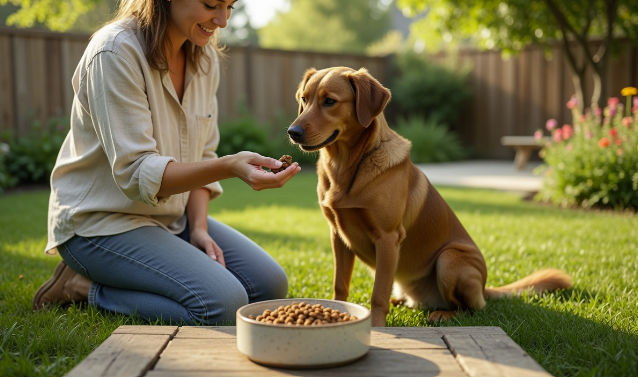
Training a dog is easier when you stop thinking of it as teaching commands and start thinking of it as teaching your dog which behaviors work.
Dogs repeat behaviors that produce useful outcomes.
If sitting calmly makes food appear, sitting becomes more valuable.
If pulling on the leash consistently gets a dog closer to the park, pulling can become stronger.
If jumping gets attention—even angry attention—the dog may continue jumping.
Good training therefore comes down to three things:
Make the behavior you want easy, reward it clearly, and prevent unwanted behavior from repeatedly paying off.
For beginners, this is much more useful than trying to establish “dominance,” punish mistakes or memorize dozens of commands.
The American Veterinary Society of Animal Behavior recommends reward-based methods for dog training and behavior modification and advises against aversive tools and techniques that rely on fear, pain or intimidation. (AVSAB)
HQ Quick Trick: Before correcting a behavior, ask: “What do I want my dog to do instead?” Then train and reward that behavior.
How Dogs Actually Learn
Dogs learn through consequences and associations.
If something pleasant regularly follows a behavior, that behavior is more likely to happen again.
This is positive reinforcement.
For example:
Dog sits → you give a treat.
Dog comes when called → you reward them.
Dog walks beside you with a loose leash → walking continues.
The reward does not always have to be food.
Depending on the dog, useful rewards can include:
- Treats
- Toys
- Play
- Praise
- Going outside
- Sniffing
- Access to another dog
- Continuing the walk
The important question is not:
“Do I think this is rewarding?”
It is:
“Does my dog behave as if this is rewarding?”
Reward-Based Does Not Mean Letting the Dog Do Anything
This is a common misunderstanding.
Reward-based training still involves:
- Rules
- Boundaries
- Preventing unwanted behavior
- Teaching alternative behaviors
- Controlling access to rewards
- Consistency
The difference is that you teach the dog what works instead of relying on intimidation or physical discomfort.
For example, if your dog jumps on visitors, reward-based training does not mean ignoring the problem forever.
You might:
- Prevent the dog from rehearsing jumping.
- Teach a reliable sit.
- Ask for the sit before greeting.
- Reward four paws on the floor.
- Temporarily remove access to the greeting if jumping begins.
The dog learns a clear rule:
Calm behavior makes greetings happen. Jumping does not.
Start With Management Before Training
Management means arranging the environment so your dog cannot constantly practice the behavior you are trying to eliminate.
This is one of the biggest shortcuts in dog training.
Imagine your puppy steals shoes ten times every day.
You might think:
“I need to teach him not to steal shoes.”
But you also need to put the shoes somewhere the puppy cannot reach.
Every successful theft gives the puppy more practice.
Management can include:
- Baby gates
- Leashes
- Closed doors
- Food stored securely
- Trash cans with lids
- Removing tempting objects
- Blocking access to windows
- Using a pen or safe area
Management is not failure.
It creates better conditions for learning.
Choose Rewards Your Dog Actually Wants
A dry piece of normal kibble might work in your quiet kitchen.
It may become almost worthless when a squirrel runs past.
Reward value depends on the environment.
You can think of rewards in three levels.
Low-Value Rewards
Useful in easy situations:
- Regular kibble
- Praise
- Familiar toy
Medium-Value Rewards
Useful around moderate distractions:
- Better treats
- Favorite toy
- Short play session
High-Value Rewards
Useful during difficult learning situations:
- Small pieces of particularly desirable food
- A favorite game
- Access to something the dog strongly wants
Use very small food rewards during repeated training so you can reward frequently without turning every session into another meal.
If you’re reviewing your dog’s overall diet at the same time, our dog food guide explains how to separate useful nutrition information from pet-food marketing.
Timing Matters More Than Beginners Realize
The reward should happen immediately after the behavior you want.
If your dog sits and you spend ten seconds finding a treat, the dog may have:
- Sat
- Stood up
- Looked away
- Jumped
before receiving it.
Which behavior did you reward?
That is where a marker becomes useful.
A marker tells the dog:
That exact behavior earned the reward.
You can use:
- A clicker
- A short word such as “yes”
The sequence becomes:
Behavior → marker → reward
For example:
Dog’s bottom touches floor.
You immediately say:
“Yes.”
Then deliver the treat.
The marker bridges the small gap between the correct behavior and receiving the reward.
Keep Training Sessions Short
Beginners often make training harder by continuing too long.
You do not need a 30-minute formal session.
Several short sessions can work better.
For example:
- 2 minutes before breakfast
- 3 minutes during a walk
- 2 minutes before dinner
- 1 minute before opening the door
The RSPCA similarly recommends beginning new training in low-distraction environments and using short, regular sessions. (RSPCA)
Stop while your dog is still engaged.
Training should feel like something good is happening—not like an endurance test.
Teach the Dog’s Name First
Your dog’s name should predict:
Pay attention to me.
Start somewhere quiet.
Say the dog’s name once.
When they look toward you:
Mark → reward.
Repeat.
Do not repeatedly say:
Max. Max. Max. Max. MAX!
Every ignored repetition teaches the dog that the word does not matter.
Say it once.
Then make it worthwhile to respond.
How to Teach Sit
Sit is useful because it can replace many unwanted behaviors.
Instead of:
- Jumping
- Charging through doors
- Climbing on you
- Leaping for food
you can teach:
Sit first.
Step 1
Hold a treat near your dog’s nose.
Step 2
Move it slowly upward and slightly backward.
Many dogs naturally lower their rear as their head follows the food.
Step 3
The instant the dog’s bottom touches the floor:
Mark → reward.
Step 4
Repeat several times.
Step 5
Once the behavior is predictable, begin adding the word:
“Sit.”
Avoid physically pushing the dog’s rear toward the floor.
Let the dog perform the behavior and reward the result.
How to Teach Down
Start in a quiet environment.
From a standing or sitting position:
- Hold a treat near the dog’s nose.
- Lower it toward the floor.
- Slowly move it outward along the ground.
- When the elbows reach the floor, mark and reward.
Some dogs find down uncomfortable or vulnerable.
Do not force the dog physically into position.
If your dog repeatedly avoids lying down or appears physically uncomfortable doing so, consider whether pain or mobility problems could be involved.
For older dogs especially, our senior dog care guide explains signs that movement changes may deserve veterinary attention.
How to Teach Stay
“Stay” is not really one skill.
It contains three separate challenges:
- Duration
- Distance
- Distraction
Beginners commonly increase all three at once.
The dog sits.
Then the owner walks ten meters away for 30 seconds while another dog passes.
That is a huge jump in difficulty.
Instead, change one variable at a time.
Start With Duration
Ask for sit.
Wait one second.
Reward.
Then perhaps two seconds.
Then three.
Add Distance
Take one small step backward.
Return.
Reward.
Add Distraction Last
Once the behavior is reliable in a quiet environment, gradually practice around mild distractions.
HQ Quick Trick: If your dog repeatedly fails, the training probably became difficult too quickly. Make the next repetition easier.
Recall: Teaching Your Dog to Come When Called
Recall is one of the most important behaviors you can teach.
It can also be accidentally damaged very easily.
Never make coming to you consistently predict something unpleasant.
Imagine this pattern:
You call your dog.
Dog comes.
You immediately:
- End play
- Give a bath
- Clip nails
- Put them alone
- Leave the park
Eventually the dog may learn:
Coming to you ends fun.
Instead, make recall heavily rewarding.
Start Recall Indoors
Use a short distance.
Say your cue once:
“Come!”
Move away slightly.
When your dog reaches you:
Mark → generous reward.
You can occasionally give several small treats instead of one.
Then let the dog return to what they were doing.
Coming to you should not always mean the activity ends.
Practice With a Long Line Before Going Off Leash
Do not test an unfinished recall around:
- Traffic
- Wildlife
- Unfenced areas
- Other dogs
Use a long training line where appropriate while building reliability.
Increase distraction gradually.
The goal is training—not discovering whether your dog happens to obey during a dangerous situation.
Do Not Poison the Recall Cue
If your dog ignores:
“Come!”
and you repeat:
Come. Come! COME! COME!
you may weaken the cue.
Instead:
- Avoid situations where failure is almost guaranteed.
- Say the cue once.
- Reward successful responses heavily.
- Gradually increase difficulty.
If your current recall word has been ignored hundreds of times, sometimes introducing a new cue and training it carefully from scratch is easier.
Loose-Leash Walking
Dogs do not automatically understand that humans prefer a loose leash.
Walking faster often works for the dog:
Pull → move forward.
If pulling continually gets the dog where they want to go, pulling is being reinforced.
A basic loose-leash system is:
When the Leash Is Loose
Move forward.
Reward periodically near your preferred walking position.
When the Leash Becomes Tight
Stop or change direction.
Forward progress resumes when the leash becomes loose.
The dog gradually learns:
Loose leash = movement continues.
You can also reward calm walking frequently during the early stages.
Walks do not need to resemble obedience competitions.
Your dog should still have opportunities to sniff and explore.
Sniffing itself can become a powerful reward:
Walk nicely for a short distance → “Go sniff.”
House Training a Puppy or New Dog
House training depends heavily on prevention and timing.
Do not wait for repeated indoor accidents and then punish the dog.
Instead, create many opportunities to succeed outside.
Take puppies or newly adopted dogs outside:
- After waking
- After eating
- After drinking significantly
- After play
- After excitement
- Before bedtime
- Regularly throughout the day
Watch for signs such as:
- Sniffing
- Circling
- Suddenly leaving the room
- Restlessness
Take the dog to the appropriate area.
When they finish toileting:
Reward immediately.
The RSPCA specifically recommends rewarding dogs immediately after toileting in the correct place rather than punishing accidents. (RSPCA)
What If an Accident Happens Indoors?
If you discover it afterward:
Clean it.
That is all.
Your dog cannot meaningfully connect punishment now with something they did long enough ago.
Punishing discovered accidents can instead teach:
Humans become frightening when urine or feces are nearby.
That can produce dogs that hide before toileting rather than dogs that understand where you want them to go.
Use an appropriate cleaner to remove the odor and improve your management schedule.
How to Stop Jumping on People
Jumping often continues because it works.
Dog jumps.
Human:
- Talks
- Touches dog
- Pushes dog
- Looks at dog
The dog receives attention.
Instead, teach an alternative behavior.
For example:
Four paws on floor → attention
or:
Sit → greeting happens
Practice with cooperative family members before expecting success with highly exciting visitors.
Management helps too.
Use a leash, gate or controlled greeting setup so the dog cannot rehearse jumping on every person entering the house.
Barking Is Not One Behavior Problem
Dogs bark for many different reasons.
A dog may bark because of:
- Alarm
- Fear
- Frustration
- Excitement
- Attention seeking
- Separation distress
- Boredom
- Territorial behavior
That means:
“How do I stop barking?”
is the wrong first question.
Ask:
“Why is this dog barking in this situation?”
A dog barking at strangers through the window needs a different plan from a dog barking because they are panicking when left alone.
Do not treat all barking with the same correction.
Chewing: Give the Dog Legal Options
Chewing is normal dog behavior, especially in young dogs.
Training should include teaching:
These things are available to chew. Those things are not.
Management is critical.
Remove:
- Shoes
- Electrical cables
- Children’s toys
- Dangerous objects
Provide safe alternatives appropriate for your dog.
If the dog picks up something inappropriate, calmly trade for an appropriate item rather than repeatedly chasing the dog around the house.
Chasing can turn theft into a very enjoyable game.
Our pet gadgets guide includes enrichment and food-dispensing options that can help give dogs appropriate outlets for activity.
“Leave It” Is More Useful Than Constantly Saying No
Teaching “leave it” gives your dog information about what you actually want.
Start with something easy.
Place a low-value item in a closed hand.
Let the dog investigate.
Wait.
The moment the dog moves away from the hand:
Mark → reward from your other hand.
Gradually increase difficulty.
Eventually you can practice with objects visible on the floor.
Do not rush directly to highly dangerous or irresistible objects.
Teach “Drop” Through Trading
Dogs may guard objects more strongly when humans constantly grab things from their mouths.
Instead, build a history of good trades.
Give the dog a low-value toy.
Offer a desirable treat.
When the dog releases the toy:
Mark → treat.
Often give the toy back afterward.
The dog learns:
Dropping things does not always mean losing them forever.
If your dog shows aggression or serious resource guarding, do not deliberately provoke it for practice.
Get qualified professional help.
Training Around Distractions
A behavior learned in your living room does not automatically transfer to the park.
Dogs do not generalize as broadly as humans often expect.
You need to practice skills in different environments.
Progress gradually:
Quiet room
↓
Another room
↓
Garden
↓
Quiet street
↓
Busier environment
If performance suddenly collapses, the environment may simply be too difficult.
Move farther away from the distraction or return to an easier setting.
Socialization Is Not “Meet Everyone”
Good puppy socialization does not mean forcing a puppy to interact with every person and dog.
The goal is to create safe, positive experiences with the world.
That can include:
- Different people
- Friendly dogs
- Surfaces
- Sounds
- Vehicles
- Grooming
- Handling
- Veterinary environments
A puppy can observe something without being forced to approach it.
If the puppy appears frightened, increase distance and make the experience easier.
Flooding a frightened puppy with overwhelming exposure can have the opposite effect from what you intended.
Food Rewards Do Not Have to Last Forever
A common concern is:
“Will I need treats forever?”
You may not need food for every repetition forever.
But removing reinforcement immediately after learning is another common mistake.
Think of training in stages.
Learning Stage
Reward frequently.
The behavior is new.
Reliability Stage
Continue rewarding while adding:
- Duration
- Distance
- Distraction
Maintenance Stage
Rewards can become less predictable.
Sometimes food.
Sometimes play.
Sometimes praise.
Sometimes access to something the dog wants.
You still reinforce good behavior.
You simply do not need to hand over a treat after every single sit for the rest of the dog’s life.
Why Punishment Can Backfire
Punishment may suppress visible behavior without solving the reason behind it.
Consider growling.
Growling is communication:
“I am uncomfortable.”
If you punish the growl successfully, you may reduce the warning without changing the dog’s discomfort.
Now you potentially have a dog that still feels threatened but gives fewer warning signals.
AVSAB’s current position is that reward-based approaches should be used for training and behavior modification and that aversive methods introduce welfare and behavioral risks. (AVSAB)
That does not mean ignoring dangerous behavior.
It means managing safety while changing the underlying behavior with an appropriate plan.
Avoid the “Alpha Dog” Trap
You do not need to:
- Alpha roll your dog
- Always eat before your dog
- Walk through every doorway first
- Physically dominate the dog
- Prove you are “pack leader”
Training is clearer when you focus on observable behavior and consequences.
Instead of:
“My dog is trying to dominate me.”
ask:
“What exactly is my dog doing, when does it happen, and what consequence is maintaining that behavior?”
That question gives you something you can actually train.
When Training Is Really a Medical Problem
Behavior changes can sometimes be related to pain or illness.
Examples include:
- Sudden aggression
- New house-soiling
- Reluctance to move
- Irritability when touched
- Sudden nighttime restlessness
- Unexpected fear
- New sensitivity to handling
Do not automatically assume the dog has become stubborn.
Medical assessment can be particularly important when behavior changes appear suddenly.
For aging dogs, our senior dog care guide covers mobility, cognitive and health changes worth monitoring.
When You Need Professional Help
Beginner training guides are useful for normal skills and everyday manners.
Some problems deserve professional assessment.
Seek appropriate help for:
- Aggression toward people
- Serious dog-to-dog aggression
- Bites
- Severe resource guarding
- Significant fear
- Separation-related distress
- Compulsive behavior
- Sudden major behavior changes
A veterinarian should also help rule out medical factors where appropriate.
For serious behavioral cases, a qualified veterinary behavior professional may be needed rather than simply a general obedience trainer.
How to Choose a Dog Trainer
Dog training is not uniformly regulated everywhere, so the title “dog trainer” by itself tells you very little.
Ask a prospective trainer:
What Happens When the Dog Gets It Right?
You want to hear about reinforcement.
What Happens When the Dog Gets It Wrong?
Be cautious if the answer revolves around pain, fear, intimidation or physical correction.
Which Tools Do You Use?
Ask directly about:
- Shock or electronic collars
- Prong collars
- Choke chains
- Physical corrections
Can I Observe a Class?
Look at the dogs.
Do they appear engaged and comfortable, or frightened and shut down?
What Education or Credentials Do You Have?
Credentials are not the only indicator of quality, but willingness to discuss education, methods and continuing learning is a good sign.
AVSAB recommends looking for professionals using humane, reward-based approaches and avoiding trainers whose methods depend on physical force or fear. (AVSAB)
A Simple Beginner Training Routine
You do not need to teach everything at once.
Start with a small foundation.
Session 1
Name response.
Sit.
Session 2
Recall indoors.
Session 3
Loose-leash practice.
Session 4
Leave it.
Session 5
Short stay.
Repeat these behaviors throughout normal life.
For example:
Before food: sit.
Before opening door: wait briefly.
During walk: reward loose leash.
Randomly indoors: call the dog and reward.
Before throwing toy: sit.
Training works faster when it becomes part of everyday interactions instead of existing only during formal lessons.
The HQTrick Three-Step Rule for Behavior Problems
When a behavior bothers you, do this before reaching for a correction.
Step 1: Prevent Practice
How can you stop the dog rehearsing the unwanted behavior repeatedly?
Step 2: Choose the Replacement
What should the dog do instead?
Step 3: Reinforce the Replacement
What reward makes that alternative worthwhile?
Example:
Problem: dog jumps at front door.
Prevent practice: use leash or gate.
Replacement: sit on mat.
Reward: visitor approaches and dog receives treats.
This framework works for many everyday problems.
How Much Does Dog Training Cost?
Training expenses vary enormously depending on:
- Location
- Group vs private lessons
- Trainer qualifications
- Complexity of the problem
- Number of sessions
For a new owner, training should be considered part of the real cost of responsible dog ownership rather than an emergency expense that appears only when behavior becomes difficult.
Our annual dog cost guide covers training alongside food, veterinary care, grooming, insurance and other recurring expenses.
Training and Pet Insurance Solve Different Problems
Pet insurance normally deals with eligible veterinary expenses.
It does not replace:
- Training
- Behavior management
- Socialization
- Environmental enrichment
Likewise, training cannot prevent every medical or emergency expense.
If you are building a complete budget for a new dog, our pet insurance guide explains deductibles, reimbursement, exclusions and how to compare policies properly.
Common Beginner Dog-Training Mistakes
Repeating Cues
“Sit, sit, sit, sit.”
Say the cue once and improve the training setup.
Training Only When Something Goes Wrong
Reward good behavior when it happens naturally.
Increasing Difficulty Too Fast
Add distractions gradually.
Using Rewards the Dog Does Not Value
Change the reward or reduce the distraction.
Inconsistent Rules
If jumping earns attention from one family member but punishment from another, the dog receives confusing information.
Punishing Fear
Fear is an emotional response, not deliberate disobedience.
Expecting Perfect Behavior Everywhere
Dogs need practice in multiple environments.
Focusing Only on Stopping Behavior
Always decide what you want the dog to do instead.
Frequently Asked Questions
What is the best dog training method for beginners?
Reward-based training is the strongest starting point.
Teach the behavior you want, mark it clearly and reinforce it with something your dog values.
How long should dog training sessions be?
Short, focused sessions are often easier for both dog and owner.
A few minutes repeated during the day can be more productive than one long session.
Should I use treats to train my dog?
Food is a convenient and effective reward for many dogs, particularly when teaching new behaviors.
Over time, reinforcement can also include toys, play, praise, access to the environment and other things your dog values.
Should I punish my dog for bad behavior?
Focus first on preventing the behavior, identifying why it occurs and teaching an alternative.
Major veterinary behavior organizations recommend reward-based approaches and advise against aversive training.
Can an older dog still be trained?
Yes.
Dogs can learn throughout life.
You may need to adjust training to physical, sensory or cognitive limitations in older dogs.
How do I get my dog to listen outside?
Reduce difficulty.
Practice at a greater distance from distractions and use better rewards.
A behavior that works in the kitchen may need substantial retraining before it works in a busy park.
Why does my dog behave well for the trainer but not for me?
The trainer may have clearer timing, reinforcement and consistency.
The solution is not to make the trainer permanent—it is for the trainer to teach you how to reproduce the same training conditions.
When should I hire a professional?
Consider professional help when you are struggling to make progress or when behavior involves aggression, biting, severe fear, separation distress or another safety or welfare concern.
Final Verdict
Successful dog training for beginners is not about showing a dog who is boss.
It is about communication.
Prevent unwanted behavior from being practiced repeatedly.
Make the correct behavior easy.
Reward it immediately.
Increase difficulty gradually.
And use mistakes as information about the training setup rather than proof that the dog is stubborn.
Start with:
- Name response
- Sit
- Recall
- Loose-leash walking
- Stay
- Leave it
Then practice those skills in everyday life.
If your dog is older, combine training with the adjustments in our senior dog care guide.
For enrichment and practical equipment, see our pet gadgets guide.
And if you are still calculating the true financial commitment of dog ownership, use our dog ownership cost guide.
The HQTrick rule: do not spend most of your time telling your dog what not to do. Make the behavior you want easier to understand and more rewarding to repeat.