
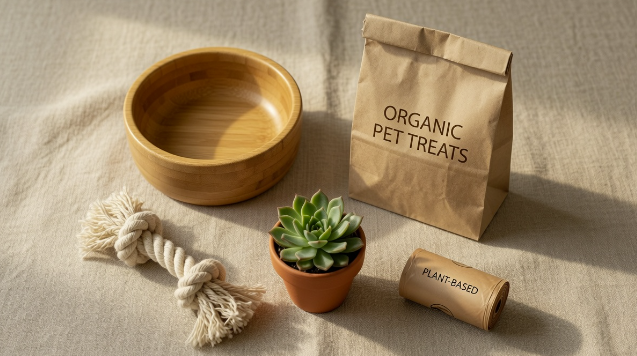
Pet products are full of environmental claims.
“Natural.” “Green.” “Biodegradable.” “Recycled.” “Sustainable.”
The problem is that those words do not automatically tell you whether a product actually reduces waste, lasts longer, or makes sense for your pet.
A product made from recycled material can still be poorly designed and need replacing every few months. A “biodegradable” waste bag may still end up in a landfill where the disposal conditions are completely different from those used in certification testing. And an expensive sustainable-looking pet accessory may provide no practical advantage over something you already own.
The better way to shop is simple:
Buy fewer things, choose products that last, understand the materials, and put your pet’s health and safety ahead of the environmental claim.
This guide shows you which types of eco-friendly pet products are genuinely worth considering—and which green claims deserve more scrutiny.
HQ Quick Trick: The most sustainable pet product is often the one you do not have to replace.
What Makes a Pet Product More Sustainable?
There is no single material or certification that automatically makes a product environmentally friendly.
Instead, look at the product’s whole practical life.
A stronger choice usually does one or more of these things:
- Lasts significantly longer than the alternative
- Uses fewer disposable components
- Can be repaired instead of replaced
- Contains clearly stated recycled content
- Uses refillable or concentrated consumables
- Reduces unnecessary packaging
- Has replacement parts available
- Can realistically be reused, recycled or composted where you live
This creates an important rule:
Durability often matters more than novelty.
Replacing a cheap toy four times can create more waste than buying one durable toy once.
The Best Eco-Friendly Pet Products by Category
Rather than ranking temporary products by price, it is more useful to identify the categories where a more sustainable choice can make a meaningful difference.
1. Durable Toys That Replace Disposable Ones
Pet toys are a perfect example of why “eco-friendly material” is not the only thing that matters.
A toy made from a fashionable natural material is not especially sustainable if your dog destroys it in ten minutes.
For dogs that chew heavily, prioritize:
- Durable construction
- Replaceable components
- Washability
- Appropriate sizing
- Recyclable or take-back materials when available
For lighter chewers, toys made from recycled textiles, natural rubber or other lower-waste materials can be reasonable choices.
But safety comes first.
Discard toys when pieces begin breaking off, and choose toys appropriate for your pet’s size and chewing behavior.
Durability Is an Environmental Feature
Imagine two toys:
Toy A costs less but lasts one month.
Toy B costs twice as much but lasts one year.
Even if Toy B does not have dramatic “green” branding, its longer usable life may reduce material consumption and waste.
That is why our guide to useful pet gadgets under $50 uses the same principle: buy products that solve a real problem rather than collecting gadgets because they look clever.
2. Stainless Steel or Durable Ceramic Bowls
Pet bowls do not need an app or complex sustainability story.
A good bowl needs to be:
- Safe for food and water
- Easy to clean
- Durable
- Difficult to tip
- Suitable for your pet
Stainless steel is particularly practical because it can last for years and is easy to clean.
Durable ceramic can also work well if it is food-safe and remains free from cracks or chips.
The environmental advantage here comes largely from longevity.
A bowl that lasts the life of a pet creates less replacement waste than repeatedly buying lightweight plastic alternatives.
Do Not Replace Something That Already Works
If you already own a safe, intact bowl, do not throw it away simply to buy a product marketed as more sustainable.
Using an existing product for its full useful life is usually better than replacing it prematurely for environmental reasons.
3. Refillable or Concentrated Grooming Products
Shampoo, conditioner and other grooming products generate recurring packaging waste.
This is where refill systems and concentrated formulas can make practical sense.
When comparing products, look for:
- Refill pouches or refill stations
- Concentrated formulas
- Clearly stated recycled packaging content
- Large sizes if you will actually use the product
- Packaging accepted by your local recycling system
Concentrated products can reduce packaging and shipping volume because less water is transported.
But again, pet safety comes first.
A shampoo is not better just because the bottle is recycled.
Choose products appropriate for the species and your pet’s skin or coat needs.
Never assume a product made for humans is automatically appropriate for a dog or cat.
4. Compostable Waste Bags—With an Important Catch
Dog waste bags are probably one of the first products people think about when trying to reduce plastic use.
But the label matters.
There is a difference between:
- Compostable
- Biodegradable
- Recycled plastic
- Plant-based plastic
These terms are not interchangeable.
A certified compostable bag may require industrial composting conditions.
That does not mean you should simply put filled pet-waste bags into your garden compost.
Many composting facilities and municipal organic-waste programs do not accept pet waste.
The Better Buying Method
Before paying extra for compostable bags:
- Check what certification the bag actually carries.
- Find out whether it is certified for home or commercial composting.
- Check whether your local waste system accepts pet waste.
- If everything will ultimately go to landfill, compare the environmental benefit realistically.
If composting is not available, another reasonable option can be bags made with verified recycled content.
The goal is not to buy the product with the greenest-looking package.
It is to choose the option that fits your actual disposal system.
5. Recycled or Long-Life Collars, Harnesses and Leashes
Collars and leashes are another area where durability can reduce waste.
Products made partly from recycled polyester or other recycled materials are available, but material content should not override safety.
For a leash or harness, first evaluate:
- Stitching
- Buckles
- Attachment points
- Correct sizing
- Comfort
- Wear resistance
Then consider recycled content.
A sustainable leash that fails while walking a dog is not a good product.
Maintain Gear Instead of Replacing It Early
Regularly inspect:
- Frayed webbing
- Rust or damaged clips
- Cracked plastic
- Loose stitching
- Damaged reflective material
Cleaning and maintaining good equipment can extend its life significantly.
If you travel regularly with your animal, our guide to traveling with pets covers carriers, restraints, identification and preparation in more detail.
6. Pet Beds With Replaceable Covers or Components
Pet beds can create a surprisingly large amount of waste.
The common problem is not the bed itself.
It is that one component becomes worn or dirty and the entire product gets thrown away.
A better design allows you to replace or wash individual parts.
Look for:
- Removable washable covers
- Replacement covers sold separately
- Replaceable filling
- Durable stitching
- Appropriate support for the pet
For an older dog, comfort and mobility support matter much more than whether the bed has impressive sustainability marketing.
Our senior dog care guide explains how traction, bedding, mobility and simple home modifications can make daily life easier for aging dogs.
7. Reusable Food and Treat Storage
Pet food often comes in packaging designed to protect freshness, so simply removing packaging is not always practical.
But you can reduce the number of additional disposable products used after purchase.
Instead of regularly buying disposable storage bags, consider durable containers that can be washed and reused.
For treats and travel:
- Reusable silicone bags
- Washable containers
- Refillable treat pouches
can replace repeated single-use packaging.
Buying the Biggest Food Bag Is Not Always Better
Large packaging can reduce packaging per unit of food.
But there is no environmental benefit if the food becomes stale or spoiled and gets thrown away.
Buy quantities your pet can consume safely while the product remains fresh.
And do not let sustainability marketing override nutrition.
For a dog’s main diet, nutritional adequacy and suitability for the individual dog come first. Our dog food guide explains what matters when choosing a complete diet and how to look beyond pet-food marketing.
Pet Food: Health First, Sustainability Second
Food can represent a major recurring part of pet ownership, so it is reasonable to consider its environmental impact.
But this is also where owners can make poor decisions by prioritizing an environmental claim over nutrition.
For a dog or cat’s main food, first confirm that it is appropriate for:
- Species
- Life stage
- Health status
- Calorie needs
For foods sold as a complete diet, look for a nutritional adequacy statement showing that the food is complete and balanced for the appropriate life stage.
Only after nutritional suitability is established should environmental factors influence the decision.
Those factors could include:
- Packaging
- Ingredient sourcing
- Manufacturing transparency
- Shipping
- Company sustainability reporting
Do not switch your pet to an unusual protein or restrictive diet solely because of an environmental claim.
Cats in particular have specific nutritional requirements that should take priority over lifestyle trends. Our cat health guide explains the fundamentals of nutrition, hydration, preventive care and healthy weight.
What About Insect-Protein Pet Food?
Insect protein is increasingly discussed as a possible lower-resource alternative to some conventional animal proteins.
That does not automatically mean every insect-based product is appropriate as a pet’s main diet.
The same rule still applies:
Check nutritional adequacy first.
A treat does not need to provide a complete diet.
A primary food does.
If you are considering an unconventional diet because of sustainability concerns, discuss it with your veterinarian—especially if your pet has allergies, gastrointestinal problems or another medical condition.
Eco-Friendly Cat Litter: What Should You Look For?
Cat litter creates a recurring waste stream, which makes alternative materials attractive.
Products can use materials such as:
- Paper
- Wood
- Corn
- Wheat
- Grass
- Other plant fibers
But environmental impact is only one part of the decision.
The litter also has to work for the cat.
Evaluate:
- Dust
- Odor control
- Tracking
- Clumping
- Texture
- Your cat’s willingness to use it
A litter your cat refuses to use is not a sustainable purchase.
Transition Gradually
If changing litter material, mix some of the new litter into the existing litter and increase it gradually.
Cats can be extremely sensitive to changes in texture and scent.
Avoid turning an environmental experiment into a litter-box avoidance problem.
The Greenwashing Test: Five Questions to Ask
“Eco-friendly” should be the beginning of your investigation, not the end.
Use these five questions before paying more for a supposedly green product.
1. What Exactly Is the Environmental Benefit?
A strong claim should be specific.
Examples:
- Contains 70% post-consumer recycled plastic
- Refillable bottle
- Replaceable cover
- Certified commercially compostable
- Made with recycled polyester
A vague claim such as:
“Earth-friendly pet product”
tells you very little.
2. Does a Certification Support the Claim?
Third-party certification can provide more useful information than a logo invented by the manufacturer.
But read what the certification actually covers.
A certification might apply to:
- Compostability
- Organic materials
- Textile processing
- Forestry
- Recycled content
It does not necessarily certify the environmental impact of the entire product.
3. Can You Dispose of It the Way the Package Suggests?
“Recyclable” does not mean your local recycling program accepts it.
“Compostable” does not mean it belongs in your backyard compost.
Check local infrastructure.
A theoretically recyclable product that no facility near you accepts is not practically recyclable for you.
4. How Long Will It Last?
Product lifespan is one of the easiest sustainability claims to overlook because companies cannot summarize it with an attractive leaf logo.
Ask:
- Is it washable?
- Can parts be replaced?
- Is it repairable?
- Will my pet destroy it quickly?
- Can another pet use it later?
Long life reduces replacement.
5. What Will I Keep Buying?
The initial product may be only part of the waste.
Check whether it requires:
- Proprietary filters
- Disposable cartridges
- Plastic refill packs
- Special batteries
- Subscription hardware replacements
This matters particularly with connected pet technology.
Our pet gadget guide explains why ongoing consumables and subscriptions belong in the buying decision from the beginning.
“Natural” Does Not Automatically Mean Better
The word natural has enormous marketing power.
But natural materials are not automatically:
- Safer
- More durable
- Less polluting
- Healthier
- Better for your pet
A synthetic product that lasts ten years may be preferable to a natural alternative that needs replacing every six months.
Similarly, a grooming product using natural ingredients can still irritate an individual animal.
Judge the actual product.
Not the aesthetic.
Bamboo Is Not Automatically Sustainable Either
Bamboo grows quickly and can be a useful renewable material.
But seeing the word “bamboo” should not end your investigation.
Look at:
- How much of the product is actually bamboo
- What other materials are mixed with it
- Durability
- Manufacturing
- Whether the product can be repaired or recycled
For example, a durable grooming brush with a bamboo handle may be a perfectly reasonable purchase.
Replacing a perfectly functional plastic brush just because bamboo looks greener is much harder to justify.
Recycled Packaging Is Good—but Do Not Confuse It With the Product
Imagine two shampoos.
Shampoo A
The formula and bottle are unchanged, but the cardboard shipping box contains recycled material.
Shampoo B
Uses concentrated product, a refill system and a durable reusable bottle.
Both improvements have value.
But they are not equivalent.
Always check whether an environmental claim refers to:
- The product
- Its container
- Shipping packaging
- One component only
The front of the package does not always make this distinction obvious.
Second-Hand Pet Products Can Be Excellent
Not every pet item has to be purchased new.
Some products can be reused safely.
Possible examples include:
- Crates
- Gates
- Carriers
- Ramps
- Pet steps
- Stainless bowls
- Some hard-plastic equipment
Clean and inspect everything carefully.
Avoid used products when wear, hygiene or unknown history could create a safety problem.
Examples might include badly worn leashes, damaged harnesses or products with cracks that are difficult to sanitize.
Buying used keeps an existing product in circulation and can also save a substantial amount of money.
The Sustainability Upgrade Most People Miss: Repair
A broken zipper should not automatically mean a new pet bed.
A damaged cover should not automatically mean a new cushion.
A lost fountain pump should not automatically mean a new fountain.
Before buying any pet product, check whether replacement components are available.
Brands that sell:
- Covers
- Pumps
- Filters
- Buckles
- Straps
- Batteries
make it easier to keep products in use.
Repairability is not as exciting as a “100% green” badge, but it can have a much more practical effect.
Sustainable Pet Care Can Also Save Money
The environmental and financial goals often overlap.
Buying fewer durable products means fewer replacements.
Reusable storage means fewer disposable bags.
Maintaining equipment extends its useful life.
Buying second-hand can lower upfront cost.
Refill systems can sometimes reduce long-term cost.
Our guide to how much a dog costs per year breaks down the major recurring expenses of dog ownership and shows why small repeated purchases can add up substantially over time.
HQ Quick Trick: Compare cost per year of use, not just purchase price.
A $15 product replaced four times per year costs more than a $40 product that lasts several years.
What Not to Replace Just to Be “Greener”
This may be the most important section in the guide.
Do not throw away functional:
- Bowls
- Leashes
- Carriers
- Beds
- Toys
- Storage containers
simply because you found a greener-looking replacement.
Use safe products until they genuinely need replacing.
When replacement time comes, choose the more durable or lower-waste option.
Sustainability should reduce consumption—not create another reason to shop.
A Better Eco-Friendly Pet Shopping Checklist
Before buying anything, ask:
Does My Pet Actually Need This?
If not, stop here.
Is the Product Safe and Appropriate?
Environmental considerations come after pet safety.
Will It Last?
Durability reduces waste and replacement cost.
Can I Repair It?
Check replacement parts before purchasing.
Is the Environmental Claim Specific?
Look for percentages, materials or clear disposal instructions rather than vague green language.
Does My Local Waste System Support the Claim?
A compostable or recyclable product must have somewhere appropriate to go.
Are There Ongoing Consumables?
Calculate filters, bags, cartridges and batteries.
Do I Already Own Something That Does the Same Job?
Using what you have is often the best option.
Building a Lower-Waste Pet Setup
You do not need to replace your entire pet setup.
Upgrade gradually when products wear out.
For Dogs
A practical lower-waste setup might include:
- Durable washable bowls
- Long-lasting toys appropriate for chewing style
- Washable bedding with replacement covers
- A durable harness and leash
- Reusable food storage
- Waste bags matched to your local disposal options
For Cats
Consider:
- Durable food and water bowls
- Washable bedding
- Repairable scratching furniture
- Reusable food storage
- A litter system your cat reliably accepts
- Durable interactive toys instead of constantly replacing disposable ones
Health remains more important than the sustainability label. For cat owners, our cat health guide provides a better foundation for nutrition, hydration and preventive care.
Frequently Asked Questions
What are the best eco-friendly pet products?
The strongest choices are usually durable, reusable or refillable products that reduce repeated purchases.
Good examples include long-lasting toys, durable bowls, washable beds with replaceable covers, reusable food storage and pet-care products with credible recycled-content or refill claims.
Are biodegradable dog poop bags actually better?
It depends on what “biodegradable” means and where the bag ultimately goes.
A vague biodegradable claim does not guarantee that a bag will quickly break down in a landfill.
Look for specific certification and check local waste-disposal options.
Are compostable dog waste bags home compostable?
Not necessarily.
Some products are designed for commercial composting rather than home composting.
Even when a bag itself is compostable, your local composting program may not accept pet waste.
Always check both the certification and local rules.
Are recycled-plastic pet products sustainable?
They can reduce demand for virgin material, but recycled content is only one factor.
Durability, manufacturing, repairability and end-of-life options still matter.
Is natural pet shampoo better?
Not automatically.
Choose grooming products based first on safety and suitability for your animal.
Natural ingredients can still cause irritation, and synthetic ingredients are not automatically unsafe.
Are sustainable pet foods better for pets?
Environmental impact and nutritional quality are separate questions.
For a pet’s primary diet, nutritional adequacy should come first.
Choose food suitable for the species, life stage and individual health needs before comparing sustainability claims.
Is buying second-hand pet equipment safe?
Some products such as crates, gates, carriers and hard equipment can be excellent second-hand purchases if they are structurally sound and can be cleaned properly.
Avoid worn safety equipment or anything whose damage could put the pet at risk.
How can I make pet ownership more sustainable without spending more?
Start by buying less.
Use existing products for their full lifespan, maintain and repair equipment, avoid unnecessary gadgets, reduce disposable products and buy used when appropriate.
Many of the most sustainable choices also save money.
Final Verdict
The best eco-friendly pet products are not necessarily the ones covered in green packaging.
They are products that:
- Solve a real need
- Keep your pet safe
- Last a long time
- Reduce repeated consumption
- Use credible environmental claims
- Can be repaired, refilled or reused where practical
Do not chase perfection.
Replacing every item in your home with a “sustainable” version creates consumption of its own.
Instead, keep what already works.
When something genuinely needs replacing, choose a durable product with specific, believable environmental benefits.
Use our pet gadget guide when deciding whether new pet technology actually solves a problem, our dog food guide when nutrition is involved, and the annual dog cost guide when balancing durability against long-term cost.
The HQTrick rule: buy less, buy better, use it longer.