
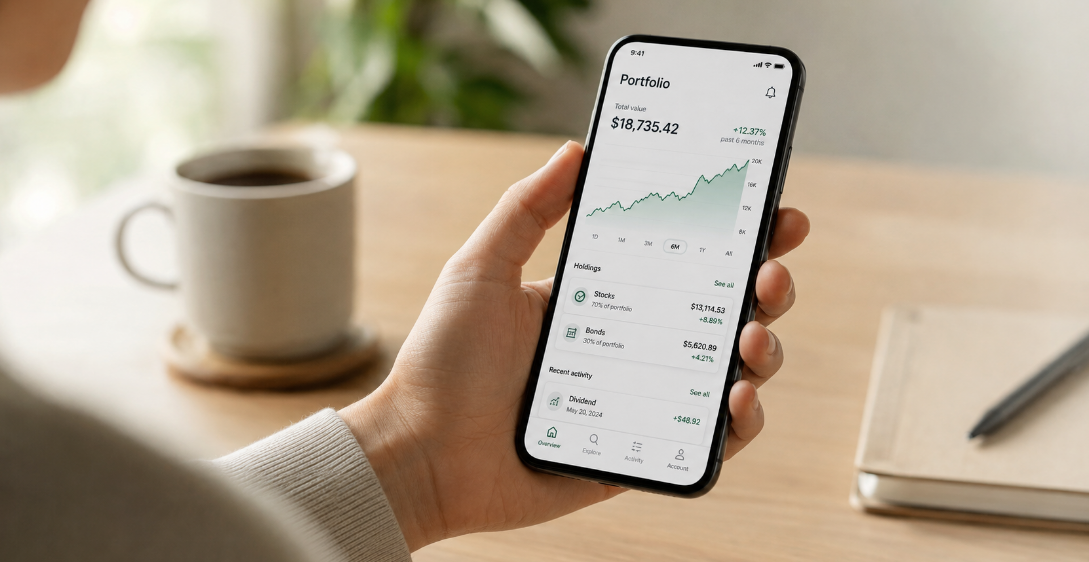
How to Start Investing with $100 (The Beginner’s Complete Guide)
Most people wait until they have “enough” money to start investing. That wait costs them more than they’ll ever realize — because time in the market is the actual asset.
Here’s how to start with exactly what you have right now.
First: Why $100 Is Enough to Start
The most expensive investing myth is that you need a significant sum before the market will work for you. The math disagrees entirely.
$100 invested at 25 years old, growing at the stock market’s historical average of roughly 10% annually, becomes approximately $1,745 by retirement at 65. That’s without adding another dollar.
The same $100 invested at 35 becomes $453. At 45, it becomes $259. The variable isn’t the amount — it’s the time. Every year you wait costs you compounding that cannot be recovered.
The real reason to start with $100: It’s not about the $100. It’s about building the habit, learning how markets move, and removing the psychological barrier of being “not yet an investor.” The person who starts with $100 and adds $50 per month consistently builds more wealth than the person waiting to invest a lump sum that never materializes.
Second: The Three Accounts You Need to Know
Before choosing what to invest in, choose where to invest. The account type determines your tax treatment — and taxes are the largest single drag on long-term investment returns.
The Roth IRA — Best First Account for Most People
A Roth IRA (Individual Retirement Account) lets you invest after-tax money that grows completely tax-free. You pay taxes on the money before it goes in — and never again. No taxes on growth, no taxes on withdrawal in retirement.
Why it’s the best first account: For most people in their 20s and 30s, paying taxes now (when income and tax rates are typically lower) to avoid taxes later (when a larger portfolio would generate larger tax bills) is a clear win. A $100,000 Roth IRA in retirement produces $100,000. A $100,000 traditional account produces less after taxes.
2024 contribution limit: $7,000/year ($583/month) Income limit: Phases out above $146,000 (single) Where to open one: Fidelity, Charles Schwab, or Vanguard — all offer Roth IRAs with no minimum and no account fees.
The 401(k) — Start Here If Your Employer Matches
If your employer offers a 401(k) match — contributing a percentage of your salary to match your own contribution — contribute enough to capture the full match before anything else. An employer match is an instant 50–100% return on that money, which no investment can guarantee.
Rule: Contribute up to the employer match first. Then open a Roth IRA. Then contribute more to the 401(k).
The Taxable Brokerage Account — After the Above
A regular investment account with no tax advantages but no contribution limits and no restrictions on withdrawal. Use this after maxing the accounts above, or if you’re investing for a goal before retirement.
Third: What to Actually Buy with Your First $100
This is where most beginners overcomplicate. The evidence-based answer is simple and consistent.
Index Funds — The Starting Point for Almost Everyone
An index fund is an investment that owns a small piece of every company in a market index — the S&P 500, for example, contains the 500 largest US companies. When you buy an S&P 500 index fund, you own a tiny fraction of Apple, Microsoft, Amazon, Google, and 497 other companies simultaneously.
Why index funds beat most alternatives for beginners:
Diversification by default. One purchase. Hundreds of companies. If one company fails, it’s a tiny fraction of your total investment.
Lower cost. Index funds charge minimal fees (expense ratios of 0.03–0.20%) because they’re not actively managed. Actively managed funds charge 0.5–1.5% and, on average, underperform index funds over the long term.
Evidence-based. Decades of research confirm that passive index investing outperforms the majority of professional fund managers over 10+ year periods. Warren Buffett has publicly recommended S&P 500 index funds for most individual investors.
The two index funds worth knowing:
VOO (Vanguard S&P 500 ETF): Tracks the 500 largest US companies. Expense ratio: 0.03%. One share costs approximately $500 — but fractional shares (buying a portion of one share) are available on most platforms for any dollar amount.
VTI (Vanguard Total Stock Market ETF): Owns the entire US stock market — large, mid, and small companies. Slightly more diversified than VOO. Expense ratio: 0.03%.
For most beginners, either of these — or a similar low-cost S&P 500 or total market fund — is the correct first investment.
Fourth: The Step-by-Step Process to Invest Your First $100
| Step | Action | Time Required |
|---|---|---|
| 1 | Open a Roth IRA at Fidelity or Schwab | 15 minutes |
| 2 | Link your bank account | 2 minutes |
| 3 | Transfer $100 to the account | Instant |
| 4 | Search for VOO or VTI | 1 minute |
| 5 | Buy $100 worth (fractional shares) | 2 minutes |
| 6 | Set up automatic monthly contribution | 3 minutes |
| Total | Under 25 minutes |
The most important step is step 6. A one-time $100 investment is a good start. A $100 monthly automatic investment is wealth building. Automation removes the decision from every subsequent month — the money moves before you can spend it.
Fifth: The Mistakes That Cost Beginners the Most
Waiting for the “right time” to invest. Market timing — trying to buy at the bottom and sell at the top — consistently underperforms simply staying invested. Time in the market beats timing the market, documented across every studied market period.
Checking your portfolio daily. Markets fluctuate. A portfolio that drops 10% in a month and recovers 12% the following month has done well — but someone who sold in the downturn locked in the loss. Check your portfolio monthly at most. Quarterly is better.
Buying individual stocks before understanding the basics. Individual stock picking is a reasonable strategy for investors with significant time to research companies. It’s the wrong starting point for someone investing their first $100. Start with index funds. Learn while your money grows. Add complexity only when you understand what you’re adding and why.
Stopping when the market drops. Market downturns feel like losses. For long-term investors, they’re discounts. Continuing automatic contributions during downturns means buying more shares at lower prices — which produces better returns when the market recovers. The investors who stayed invested through every major market crash historically outperformed those who left.
Paying high fees without realizing it. A 1% annual fee sounds small. On a $50,000 portfolio over 20 years, the difference between a 0.03% expense ratio and a 1% expense ratio is approximately $30,000 in lost returns. Always check expense ratios before buying.
Sixth: What Comes After Your First $100
The $100 is the beginning of a system, not a destination.
Month 1: Open the account, make the first investment, set up automatic contributions.
Months 2–6: Don’t touch it. Let the habit build. Add more if you can — even $25 more per month matters.
Month 6: Review the account. Not to react to performance, but to confirm the automatic contributions are running and the fund choice still makes sense.
Year 1: Consider increasing the monthly contribution with any raise or bonus. The portfolio is growing on its own — your job is simply to add to it consistently.
Year 2+: Read more about investing. Learn about asset allocation, bonds, international diversification. Add complexity gradually as understanding grows.
The goal isn’t to become an expert investor. It’s to build a system that grows your wealth while you live your life — requiring minimal time and minimal decisions.
Conclusion: The Best Investment Is the One You Actually Make
The perfect portfolio that sits in a spreadsheet waiting for the right moment produces exactly nothing.
The imperfect portfolio started today with $100 has decades of compounding ahead of it.
Start. Adjust later.
HQTRICK.COM — Your Daily Trick to a Better Life