
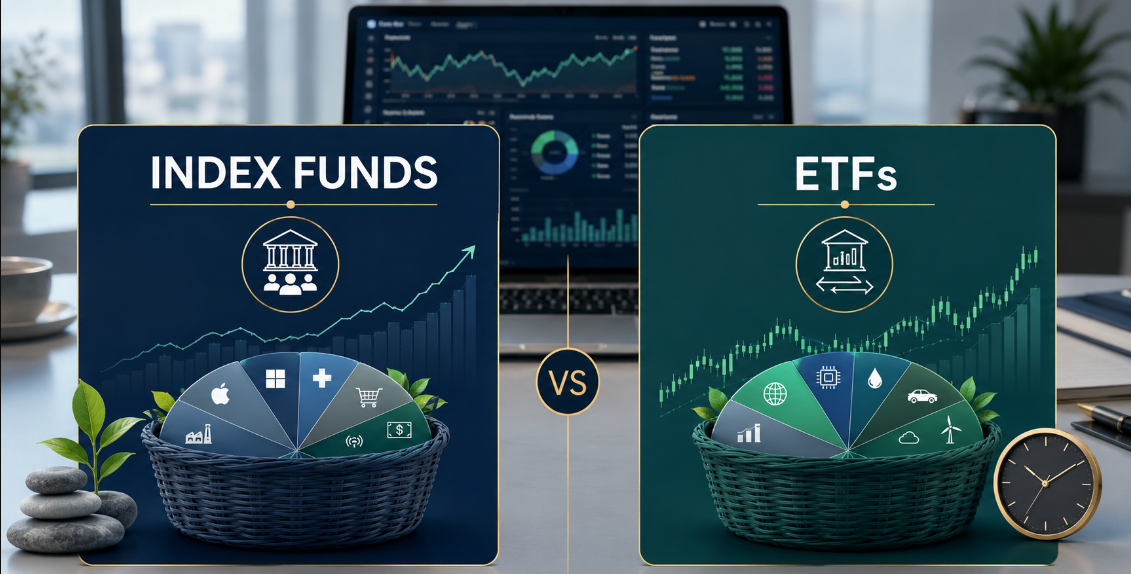
Index Funds vs ETFs — What’s the Real Difference?
Most beginners treat “index fund” and “ETF” as synonyms. Most experienced investors know they’re not — but struggle to explain exactly why.
Here’s the clear answer, without the jargon.
First: What They Actually Are
Before comparing them, the definitions matter — because the confusion between these two terms starts with a category error.
An index fund is a strategy. It’s any fund designed to track a market index — the S&P 500, the total US stock market, the bond market — by holding the same securities in the same proportions as that index. The goal is to match the market’s performance, not beat it.
An ETF (Exchange-Traded Fund) is a structure. It’s a type of fund that trades on a stock exchange throughout the day, like a share of Apple or Google. You buy and sell it at market price during trading hours.
The overlap that causes the confusion: Most ETFs are index funds. Most popular index funds are structured as ETFs. When someone says “I invest in ETFs,” they usually mean “I invest in index-tracking ETFs” — which is passive index investing. But not all ETFs track indexes (there are actively managed ETFs), and not all index funds are structured as ETFs (mutual fund index funds exist and are widely used).
The distinction isn’t index vs ETF — it’s the investment strategy (passive index tracking vs active management) versus the fund structure (ETF vs mutual fund).
Second: The Practical Differences That Actually Matter
How You Buy and Sell
ETFs: Trade like stocks. You buy and sell them during market hours at the current market price. One click, instant execution. You can buy one share — or a fraction of a share on most modern platforms.
Mutual fund index funds: Priced once per day, after the market closes. You place an order and it executes at the end-of-day price regardless of when you submitted it. You invest a dollar amount, not a number of shares.
Practical impact: For long-term investors making monthly contributions, this difference is largely irrelevant. You’re not trying to time the market — you’re buying regularly and holding. Either structure works equally well.
Minimum Investment
ETFs: No minimum beyond the price of one share — and fractional shares on platforms like Fidelity, Schwab, and Robinhood remove even that barrier. You can invest $1 in most ETFs today.
Mutual fund index funds: Traditional minimums of $1,000–$3,000, though Fidelity offers several zero-minimum index mutual funds (FZROX, FZILX) that have eliminated this barrier entirely.
Practical impact: Used to be a meaningful difference. Now largely resolved by fractional shares and zero-minimum mutual funds.
Tax Efficiency
ETFs have a structural tax advantage over mutual funds due to how they handle redemptions. When investors sell mutual fund shares, the fund sometimes must sell underlying holdings to raise cash — potentially triggering capital gains taxes for all remaining investors in the fund, even those who didn’t sell.
ETFs use an “in-kind” redemption process that avoids this. The result: ETFs rarely distribute capital gains to investors, making them more tax-efficient in taxable brokerage accounts.
Practical impact: Meaningful in a taxable account. Irrelevant inside a Roth IRA or 401(k), where taxes don’t apply to investment activity.
Automatic Investment
Mutual fund index funds: Most brokerages allow automatic monthly investments into mutual funds — set a date, set an amount, done. The fund handles the fractional math automatically.
ETFs: Automatic investing in ETFs is available at Fidelity and M1 Finance but not universally. Some platforms require you to manually purchase ETF shares each month.
Practical impact: If automation is important to you and your brokerage doesn’t support ETF auto-invest, a mutual fund index fund removes friction from the monthly contribution process.
Third: The Direct Comparison
| Feature | ETF | Index Mutual Fund |
|---|---|---|
| Trading | Anytime during market hours | Once daily at close |
| Minimum investment | Price of 1 share (or $1 fractional) | $0–$3,000 depending on fund |
| Tax efficiency | Higher (in taxable accounts) | Slightly lower |
| Auto-invest | Limited (platform-dependent) | Widely supported |
| Expense ratios | 0.03–0.20% typically | 0.03–0.20% typically |
| Best account | Taxable brokerage | IRA or 401(k) |
| Example | VOO, VTI, QQQ | FXAIX, VTSAX, SWTSX |
Fourth: The Funds Worth Knowing by Name
These are the specific funds that appear in most evidence-based investing conversations:
For US stock market exposure:
VOO (Vanguard S&P 500 ETF): Tracks the 500 largest US companies. Expense ratio: 0.03%. The ETF equivalent of VFIAX.
VTI (Vanguard Total Stock Market ETF): Owns the entire US market — large, mid, and small companies. Expense ratio: 0.03%. Slightly broader than VOO.
FXAIX (Fidelity 500 Index Fund): Fidelity’s mutual fund equivalent of VOO. No minimum, expense ratio 0.015%. Slightly cheaper than VOO on fees.
FZROX (Fidelity Zero Total Market Index Fund): Zero expense ratio. The cheapest index fund available. Fidelity-exclusive — only available if you use Fidelity.
For international exposure:
VXUS (Vanguard Total International Stock ETF): Owns stocks from developed and emerging markets outside the US. Expense ratio: 0.07%.
FZILX (Fidelity Zero International Index Fund): Zero expense ratio international fund. Fidelity only.
For bond exposure:
BND (Vanguard Total Bond Market ETF): The most widely held bond ETF. Provides stability to offset stock market volatility. Expense ratio: 0.03%.
Fifth: Which to Choose for Your Situation
✅ Choose ETFs if:
- You invest in a taxable brokerage account where tax efficiency matters
- Your platform supports fractional ETF shares and automated ETF purchases
- You want the flexibility to buy and sell at any point during the trading day
- You’re already using a platform like Fidelity, Schwab, or Robinhood where ETFs work seamlessly
✅ Choose index mutual funds if:
- You’re investing inside a Roth IRA or 401(k) where tax efficiency doesn’t apply
- You want automated monthly contributions without managing the purchase manually
- You’re using Fidelity and want zero-cost options (FZROX, FZILX)
- You prefer investing exact dollar amounts rather than dealing in shares
✅ The honest answer for most beginners:
It doesn’t matter as much as picking one and starting.
A $100/month investment in VTI and a $100/month investment in FZROX will produce nearly identical outcomes over 30 years. The expense ratio difference between the cheapest ETF and the cheapest mutual fund is measured in hundredths of a percent. The difference between starting today and waiting six months to choose the “right” structure is thousands of dollars of lost compounding.
Pick either. Start now. Optimize later if it matters.
Conclusion: The Structure Is Not the Strategy
Index funds and ETFs are not competing philosophies. They’re two vehicles driving to the same destination — broad market exposure at the lowest possible cost.
The strategy (passive index investing) is what matters. The structure (ETF or mutual fund) is a detail that rarely changes the outcome for long-term investors.
HQTRICK.COM — Your Daily Trick to a Better Life