
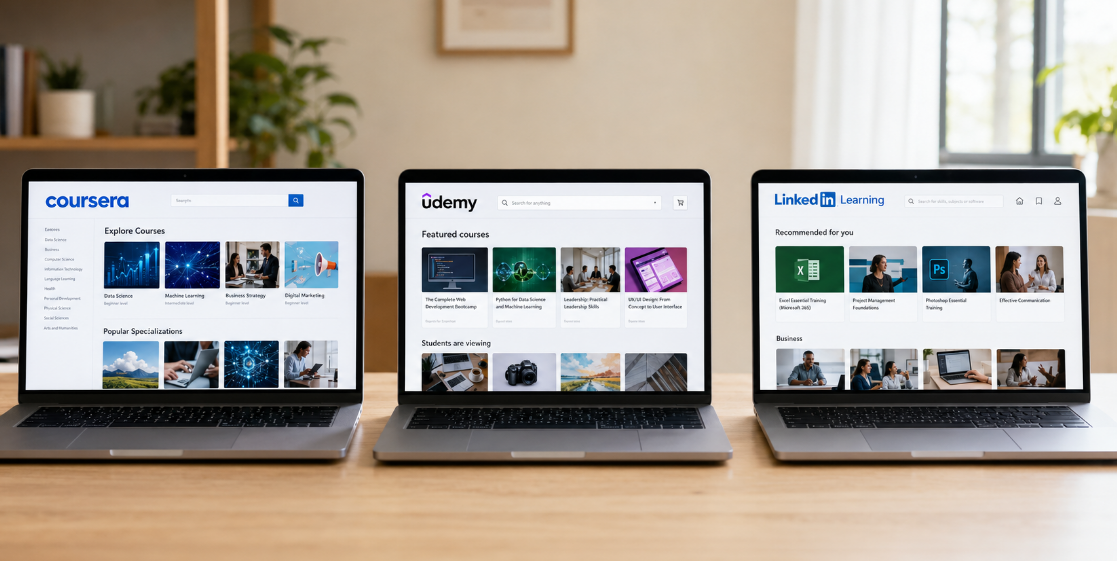
Coursera vs Udemy vs LinkedIn Learning — Which Platform Is Actually Worth Your Time?
Everyone tells you to “take an online course.” Nobody tells you which platform — or why choosing the wrong one wastes months of effort on credentials that go nowhere.
Here’s the breakdown that most comparison articles skip: the best platform depends entirely on what you’re trying to achieve, not which one has the most courses.
First: Why These Three Dominate — And What Makes Each One Different
Before comparing prices and features, you need to understand the philosophy behind each platform — because they were built for different people solving different problems.
Coursera was built around universities. Courses come from institutions like Stanford, Yale, and Google. The content is rigorous, structured like a real semester, and the certificates carry institutional weight that matters in specific professional contexts.
Udemy was built around instructors. Anyone with expertise can create and sell a course. The quality ceiling is high and the quality floor is low — you’ll find both outstanding practitioner-taught content and outdated recordings from 2018. The price model (courses for $10–$15 on frequent sales) makes it accessible, but also means you do your own quality filtering.
LinkedIn Learning was built around the professional ecosystem. Courses are produced in-house, integrated directly with your LinkedIn profile, and recommended based on your career path. Content leans toward professional skills and software tools rather than deep academic subjects.
The platform that matches your goal is the right platform. All three are legitimate — the mistake is using the wrong one.
Second: What Each Platform Does Best
Coursera — Best for Academic Credentials and Career Changers
Coursera’s strength is the weight behind its certificates. A Google Data Analytics Certificate or IBM Data Science Professional Certificate carries recognition that a random Udemy course doesn’t — because hiring managers know the curriculum came from a recognized organization.
Where Coursera genuinely leads:
- Structured learning paths: Specializations and Professional Certificates guide you through a complete skill set in the right order.
- University degrees: Accredited bachelor’s and master’s degrees at a fraction of on-campus tuition. A University of Illinois MBA on Coursera costs around $22,000.
- Free audit option: Most Coursera courses can be audited for free — full video and reading access, no certificate. Genuinely useful for learning without the credential signal.
Where Coursera falls short: University-style pacing doesn’t suit everyone. If you need to learn a specific tool quickly, Coursera’s semester-length structure is the wrong format. The $59/month subscription also adds up if you’re not moving through content consistently.
Udemy — Best for Specific Skills and Practical Tools
Udemy’s marketplace model produces its best results for practical, tool-specific learning. The best Udemy courses are taught by practitioners who use the skills daily — and teach with real-world examples that academic platforms often lack.
Where Udemy genuinely leads:
- Specific tools: Learning Figma, Excel, Python, video editing, WordPress — Udemy has deep practitioner-taught courses for virtually every tool.
- Price: Courses go on sale constantly, dropping to $10–$15 on promotions that happen almost every week.
- Lifetime access: Buy once, keep forever — including all future updates. No subscription to cancel.
- Volume: 210,000+ courses. Whatever you need to learn, it’s almost certainly there.
Where Udemy falls short: Quality varies enormously. Without careful filtering, you can waste money on outdated or poorly structured content. Certificates also carry minimal external recognition compared to Coursera’s institutional offerings.
How to filter Udemy effectively: Look for courses with at least 4.5 stars, over 1,000 ratings, and an update date within the past year. Always preview the first few lessons before buying.
LinkedIn Learning — Best for Professional Visibility
LinkedIn Learning’s integration with your profile is its real differentiator — completed courses appear directly on your LinkedIn, visible to recruiters. For someone actively job searching, this matters.
Where LinkedIn Learning genuinely leads:
- Professional software: Microsoft Office, project management, business communication — consistently high-quality and current.
- Short-form content: Most courses run 1–4 hours. For busy professionals who need a quick skill refresh, this format fits real-world time constraints.
- Free via library: Many public libraries provide full LinkedIn Learning access with a library card. One of the most underused free resources available.
Where LinkedIn Learning falls short: Depth doesn’t match Coursera or Udemy for technical subjects. For coding, data science, or deep technical skills, LinkedIn Learning serves as an introduction rather than real training. The $39.99/month cost is also relatively high for what you get.
Third: The Price Comparison That Actually Matters
| Coursera | Udemy | LinkedIn Learning | |
|---|---|---|---|
| Individual course | $49–$99 | $10–$15 (sale) | Not available |
| Subscription | $59/month | Not available | $39.99/month |
| Free option | Audit (no cert) | 30-day refund | Library card |
| Best value | $399/year (Plus) | Single course on sale | Library free tier |
| Certificate | Yes — shareable | Yes — limited recognition | Yes — LinkedIn profile |
The honest value calculation:
- Completing two or more Specializations per year → Coursera Plus at $399/year is excellent value.
- Buying one course every few months → Udemy at $12 wins easily.
- Actively job searching and want visible development → LinkedIn Learning’s monthly plan pays for itself.
Fourth: Which Platform for Which Goal
This is the only question that matters. Not which is “best,” but which fits your specific situation right now.
Use Coursera if: You’re making a significant career change and need credentials that signal serious commitment. You benefit from structured learning with deadlines. You want a certificate from Google, IBM, or a real university.
Use Udemy if: You need a specific tool or skill quickly. Budget is tight. You prefer self-paced learning without deadlines. You want lifetime access to revisit anytime.
Use LinkedIn Learning if: You’re job searching and want visible professional development. You need short, focused courses to stay current on business tools. You have library card access to use it for free.
Use multiple platforms: Most serious learners use all three — LinkedIn Learning for quick professional skills, Udemy for specific tools, Coursera when a recognized credential matters. They serve genuinely different needs and work best together.
Fifth: Free Options Worth Knowing Before You Spend Anything
Before paying for any platform, these free options often cover exactly what you need:
Coursera audit: Full video and reading access to most courses, completely free. No certificate, no graded work. Sufficient for learning without the credential.
LinkedIn Learning via library: Hundreds of public library systems — New York, Los Angeles, and many others — provide full access with a library card. Check your local library first.
YouTube: Underestimated as a learning platform. For many technical skills, free practitioner tutorials match or exceed paid course content. The lack of structure is the main limitation.
Sixth: Three Checks Before Buying Any Course
Regardless of platform, run these three checks before every purchase:
Check the last update date. A Python course from 2019 may teach outdated practices. A cloud computing course two years old may reference deprecated tools. Recency matters in technology subjects.
Read the one-star reviews. Five-star reviews tell you what the course does well. One-star reviews tell you what it fails to do — often revealing whether the failure is fundamental or minor.
Watch the preview lessons. Teaching style is personal. A highly rated course taught by someone whose communication style doesn’t work for you is still a bad purchase. Most platforms offer free previews. Use them every time.
Conclusion: The Best Platform Is the One You’ll Actually Finish
The most expensive online course is the one you start and never complete.
Pick the platform whose format matches how you actually learn. A finished $12 Udemy course produces more real value than an abandoned $59/month Coursera subscription — every time.
HQTRICK.COM — Your Daily Trick to a Better Life