
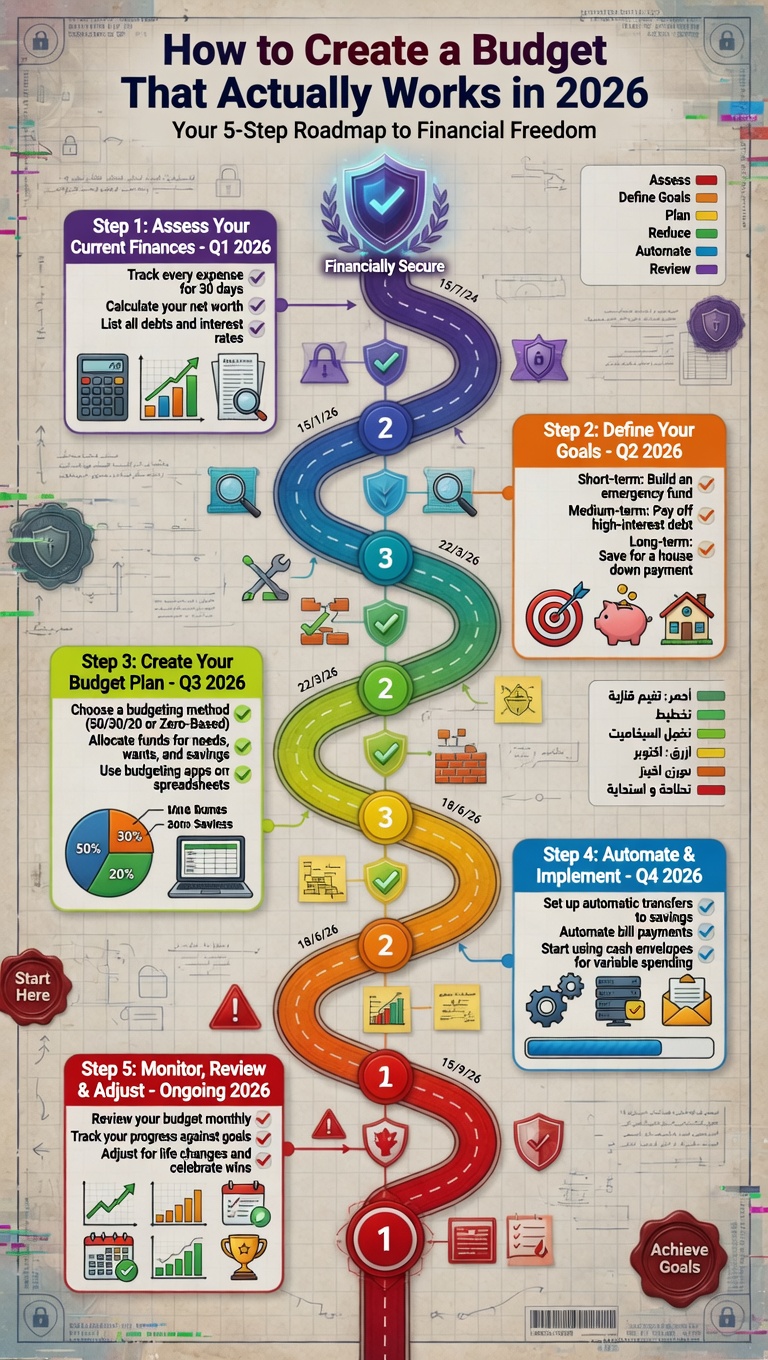
How to Create a Budget That Actually Works in 2026
Most budgeting advice fails because it’s built around an ideal version of your life — not the actual one. You’re told to cut coffee, stop eating out, and save 20% of your income. Then real life happens, and you abandon the whole thing by week two.
This guide is different. It’s built around how people actually spend money — with systems that bend instead of breaking.
Why Most Budgets Fail (And the Fix)
The core problem with traditional budgets: they’re too rigid. They assume your expenses are identical every month, your income is perfectly predictable, and your willpower is infinite. None of those things are true.
The budgets that work in 2026 share three traits:
They’re flexible. They account for irregular expenses — car repairs, medical bills, annual subscriptions — instead of pretending they won’t happen.
They’re automated. The less you have to remember to do, the more consistently it happens.
They’re honest. They’re built around what you actually spend, not what you think you should spend.
Step 1: Know Your Real Numbers (30 Minutes)
Before you build any budget, you need accurate data. Most people underestimate their spending by 20–30%.
Do this:
- Open your bank and credit card statements from the last 3 months
- Add up what you spent in each category: housing, food, transport, subscriptions, entertainment, personal care, everything else
- Divide by 3 to get your monthly average
Don’t edit the numbers. Don’t feel bad about them. Just see them accurately. This is the only way to build a budget that’s grounded in reality.
Common shock moments:
- Subscriptions often total $150–$300/month when you add them all up
- “Eating out a little” is frequently $400–$600/month
- Small daily purchases (coffee, convenience stores) often hit $200+/month
None of this is shameful — it’s just data. Now you can work with it.
Step 2: Choose Your Budgeting Method
There’s no single right method. Here are the three that work best for most people:
The 50/30/20 Rule (Best for Beginners)
Divide your after-tax income into three buckets:
- 50% — Needs (rent, utilities, groceries, minimum debt payments, transport)
- 30% — Wants (dining out, entertainment, subscriptions, shopping)
- 20% — Savings and extra debt payments
This is the simplest structure to follow. If your needs exceed 50%, you adjust the wants/savings split — not the method.
Zero-Based Budgeting (Best for Detail-Oriented People)
Every dollar of income gets assigned a job before the month begins. Income minus all allocated expenses equals zero — not because you spent everything, but because every dollar has a purpose, including savings.
Apps like YNAB (You Need a Budget) are built around this method and make it significantly easier to track.
Pay Yourself First (Best for Savers)
The moment you get paid, automatically transfer your savings target (10%, 15%, 20%) to a separate account. Budget the rest. This removes the decision from your hands entirely.
Step 3: Build Your Budget in Three Columns
On paper, a spreadsheet, or a budgeting app, create three columns:
| Category | Actual (Last 3 months avg) | Budget (This Month) |
|---|---|---|
| Rent/Mortgage | $1,400 | $1,400 |
| Groceries | $320 | $300 |
| Eating Out | $480 | $350 |
| Transport | $210 | $200 |
| Subscriptions | $187 | $120 |
| Entertainment | $160 | $100 |
| Savings | $0 | $200 |
| … | … | … |
The middle column is your baseline. The right column is your target — adjusted, not fantasized. If you spent $480 on eating out last month, setting a $50 target is a setup to fail. Setting $350 is ambitious but achievable.
Step 4: Handle Irregular Expenses (The Step Most People Skip)
This is where most budgets fall apart. Car maintenance, medical costs, home repairs, annual subscriptions, holiday gifts — these aren’t surprises. They’re predictable expenses that happen at unpredictable times.
The fix: a sinking fund.
Estimate your irregular annual expenses, divide by 12, and set that amount aside monthly into a dedicated account.
Example:
- Car maintenance/repairs: $800/year → $67/month
- Medical copays: $400/year → $33/month
- Holiday gifts: $600/year → $50/month
- Annual subscriptions (Adobe, etc.): $360/year → $30/month
- Total: $180/month set aside
When the expense hits, the money is already there. No budget busting. No credit card debt.
Step 5: Automate Everything You Can
The most effective budgeting system is the one you have to think about least.
Automate these immediately:
- Savings transfer — same day as payday, automatic
- Retirement contributions (401k, IRA) — automatic via payroll or bank
- Sinking fund transfers — automatic, day after payday
- Bill payments — auto-pay for fixed bills (rent, utilities, insurance)
What’s left over is your discretionary spending. You don’t need to track every coffee — you just need to not spend more than what remains.
Step 6: Review Weekly for 15 Minutes
Budgets aren’t set and forget. The most successful budgeters do a brief weekly check-in:
- How much has been spent in each category so far this month?
- Are any categories running over early?
- Any unexpected expenses coming this week?
- Any adjustments needed?
15 minutes on Sunday prevents the end-of-month panic of realizing you’ve already blown the restaurant budget by the 10th.
The Best Budgeting Tools in 2026
YNAB (You Need a Budget) — $14.99/month The gold standard for zero-based budgeting. Steep learning curve, but users report dramatically improved financial outcomes. Free 34-day trial.
Rocket Money — Free / $6–12/month premium Excellent for identifying and canceling subscriptions. The premium plan adds budgeting features and credit score monitoring.
Copilot Money — $13/month The most polished budgeting app available in 2026. Best interface, strong categorization, Apple-focused.
Spreadsheet (Google Sheets — Free) The most flexible option. No subscriptions, complete customization, and forces you to understand your numbers deeply. Templates available at no cost.
Which to choose: Start with a free spreadsheet or Rocket Money to understand your spending patterns. Upgrade to YNAB if you want a structured system that guides your decisions.
The Most Common Budget-Busting Mistakes
Cutting too aggressively in week one. Sustainable change is gradual. Cut 20% of discretionary spending this month, not 80%.
Not accounting for irregular expenses. Build the sinking fund. This single step prevents more budget failures than anything else.
Forgetting your spending partner. If you share finances with someone, a budget they didn’t help create is a budget they won’t follow. Build it together.
Giving up after one bad month. Every budget fails occasionally. The measure of success is how quickly you reset and continue, not whether you ever go over.
What a Working Budget Actually Feels Like
A budget that works doesn’t feel like deprivation. It feels like clarity. You know exactly what’s available for the things you enjoy. You know your bills are covered. You know money is moving toward your goals automatically. The low-grade financial anxiety that most people carry dissolves — not because you earn more, but because you understand where everything goes.
That’s the real goal. Not perfection. Clarity.
Want to make budgeting even easier? Read: [How to Use ChatGPT to Build Your Personal Budget in Minutes] — AI can do half the setup work for you.