
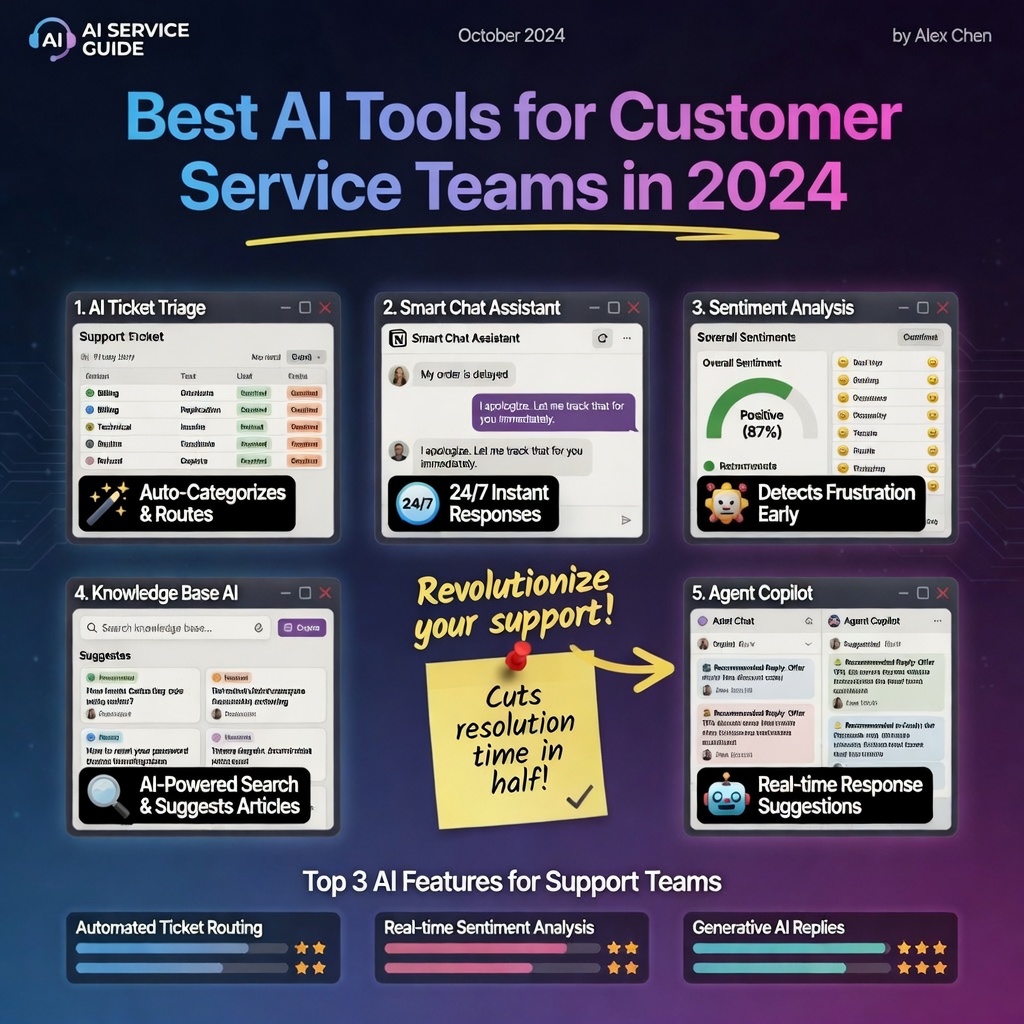
Best AI Tools for Customer Service Teams in 2026
Customer service is one of the highest-volume, most repetitive professional environments in the business world — and one of the most transformed by AI. In 2026, the question isn’t whether to use AI in customer service. It’s which tools to use, where to draw the line between AI and human agents, and how to maintain the human connection that builds loyalty.
This guide focuses on tools that are delivering real improvements — faster resolution, higher satisfaction scores, and reduced agent burnout — without sacrificing the customer experience.
The Three Layers of AI in Customer Service
Understanding where AI fits prevents misapplication:
Layer 1: Deflection — AI handles common questions before they reach a human agent. FAQ chatbots, knowledge base search, automated order status updates. Goal: resolve 30–50% of contacts without agent involvement.
Layer 2: Augmentation — AI assists human agents in real time. Suggested responses, sentiment alerts, automatic ticket summarization, relevant knowledge base articles surfaced instantly. Goal: make agents faster and more accurate.
Layer 3: Analysis — AI processes conversation data to identify trends, training gaps, emerging issues, and customer sentiment at scale. Goal: give managers insights that would take weeks to gather manually.
The best customer service AI strategies deploy all three layers.
7 Best AI Tools for Customer Service Teams in 2026
1. Intercom — Best All-in-One AI Support Platform
Best for: SaaS companies, tech products, digital-first businesses Cost: From $39/seat/month
Intercom has transformed from a messaging platform into a comprehensive AI customer service suite. The Fin AI Agent — their primary chatbot — is genuinely impressive in 2026, capable of:
- Answering complex product questions by reading your knowledge base
- Handling multi-turn conversations with contextual understanding
- Escalating to human agents with full conversation context when needed
- Learning from human agent responses to improve over time
The human handoff is smooth — agents see the full AI conversation and can take over without asking the customer to repeat themselves. Fin resolution rates of 40–60% are common for well-configured deployments.
2. Zendesk AI — Best for Established Helpdesk Users
Best for: Teams already using Zendesk Cost: AI features included in Suite plans from $55/agent/month
Zendesk’s AI features are deeply integrated into the ticketing workflow. Key features:
- Intelligent triage: Automatically categorizes, tags, and routes tickets based on content
- Agent Copilot: Suggests responses and surfaces relevant articles while agents type
- Ticket summarization: Condenses long conversation threads for agents picking up a ticket mid-stream
- QA automation: Automatically reviews agent responses for quality and compliance
For teams already on Zendesk, these features significantly increase agent throughput without additional tools.
3. Freshdesk AI (Freddy) — Best Value for Mid-Size Teams
Best for: Growing customer service teams; cost-conscious buyers Cost: AI features from $15/agent/month
Freshdesk’s AI assistant Freddy provides a strong set of features at a lower price point than enterprise alternatives:
- Article suggestions surfaced in real time as agents type
- Automatic ticket categorization and routing
- Chatbot for common query deflection
- Sentiment analysis on incoming tickets
- CSAT prediction based on conversation tone
A solid choice for teams of 5–50 agents who need AI without enterprise pricing.
4. Claude / ChatGPT — Best for Response Drafting and Training Content
Best for: Drafting response templates, creating knowledge base articles, training material Cost: Free–$20/month
General AI tools are surprisingly useful for the support knowledge layer:
Response templates: “Write 10 response templates for a customer service team handling a SaaS product. Cover: billing disputes, feature requests, login issues, refund requests, and account cancellation. Tone: warm, professional, solution-focused.”
Knowledge base articles: “Write a help center article explaining how to [feature] in [product]. Write for a non-technical user. Include: overview, step-by-step instructions, common issues, and where to get more help.”
Training scenarios: “Create 5 difficult customer service scenarios for agent training. Include: angry customer, repeated contacts on same issue, feature complaint, competitor comparison. For each, include the ideal agent response.”
5. Gong — Best for Quality Assurance and Coaching
Best for: Teams with phone/video support; sales-adjacent support Cost: Contact for pricing; enterprise
Gong analyzes customer calls using AI to identify: talk time ratios, customer sentiment shifts, topics that correlate with escalation, and coaching opportunities. Originally built for sales, it’s increasingly used in customer success and support:
- Managers can review AI-flagged calls instead of random sampling
- Common complaint themes surface automatically across hundreds of calls
- Coaching is based on actual conversation patterns, not observation bias
6. Tidio — Best for Small Business Chatbots
Best for: E-commerce, small businesses, website chat Cost: Free tier; paid from $29/month
Tidio offers a user-friendly AI chatbot specifically designed for small business customer service. Setup is genuinely fast — connect your product catalog, FAQs, and policies, and the AI starts handling common questions within hours.
The free plan is generous enough to handle significant chat volume. For e-commerce teams handling order inquiries, shipping questions, and returns at volume, Tidio is one of the highest-ROI tools available.
7. Observe.AI — Best for Contact Center Analytics
Best for: High-volume contact centers with phone support Cost: Contact for pricing; enterprise
Observe.AI analyzes 100% of customer calls automatically — not just the sample a QA team can manually review. It identifies compliance violations, training gaps, customer churn signals, and agent performance patterns across thousands of daily calls.
The shift from sampling 2% of calls to analyzing 100% is transformative for quality management.
Implementation Priorities for Customer Service Managers
Month 1: Deploy a knowledge base chatbot for your top 20 most common questions. Measure deflection rate.
Month 2: Enable agent assist features — suggested responses and real-time article surfacing. Measure handle time and CSAT impact.
Month 3: Add ticket triage automation. Measure routing accuracy and first-contact resolution rate.
Month 4: Start analyzing conversation data for trends and training opportunities.
The Human Balance Point
The teams with the best outcomes aren’t those with the most AI — they’re the ones who’ve drawn the right line between AI and human involvement.
AI handles: volume, repetition, triage, data, and 24/7 availability. Humans handle: emotional situations, complex problems, high-value relationships, and anything requiring judgment and empathy.
The best customer service AI doesn’t reduce headcount — it lets the same team handle more volume while spending their human time on the contacts that genuinely need it.