
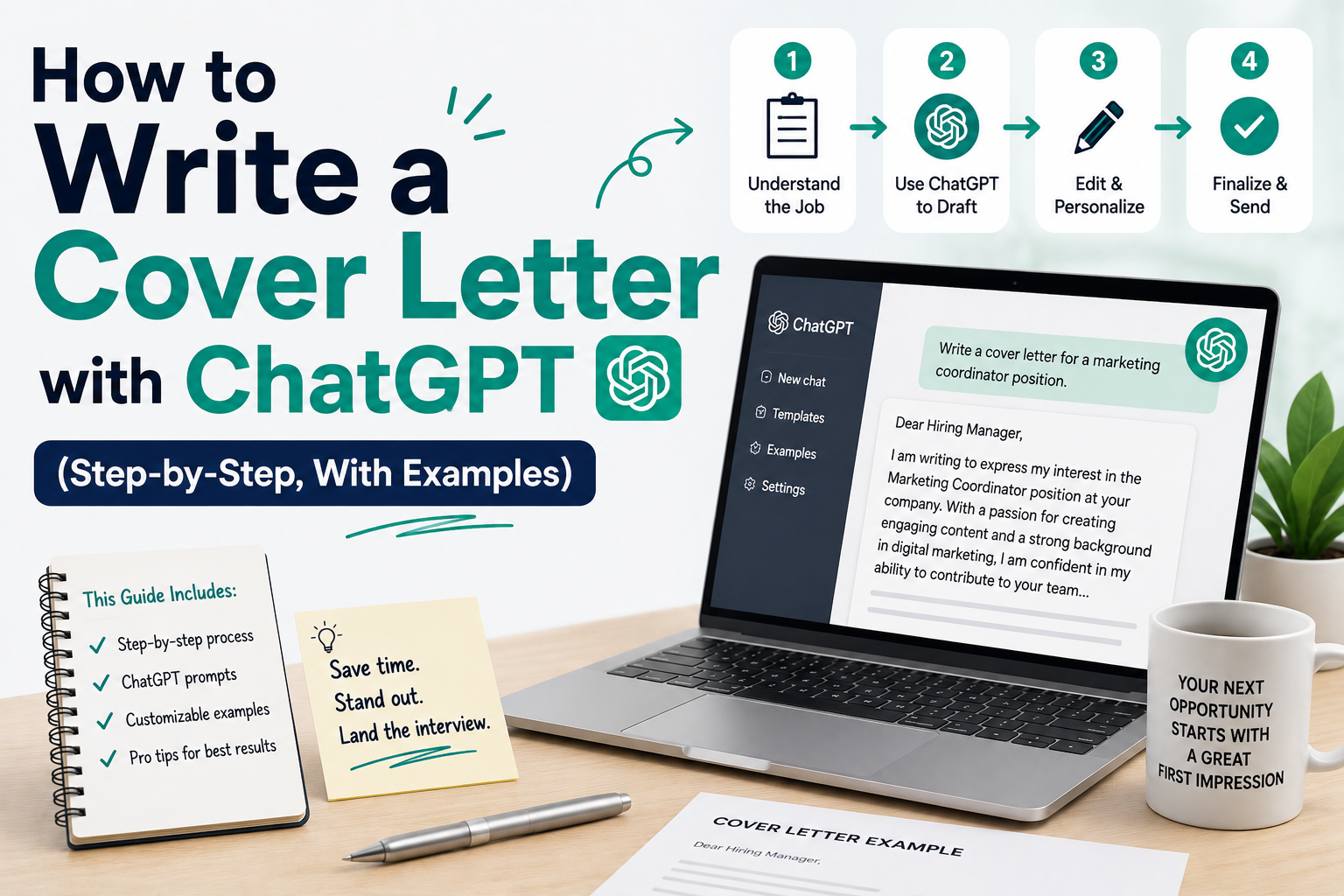
How to Write a Cover Letter with ChatGPT (Step-by-Step, With Examples)
Cover letters are one of the most dreaded writing tasks in any job search — and one of the most wasteful. The average job seeker rewrites the same letter 20 times for 20 slightly different jobs, tweaking words and hoping for a hit. ChatGPT eliminates most of that effort while producing letters that are actually more tailored than what most people write manually.
This guide shows you the exact process: what to give ChatGPT, the prompts to use, and how to review and personalize the output so it sounds like you.
Why Most AI Cover Letters Fail (And How to Avoid It)
The worst AI cover letters fail for one reason: generic input produces generic output. If you paste a job description and say “write me a cover letter,” you get the same letter 10,000 other people got this week.
The fix is specificity. The more specific your input, the more specific the output. This guide is built around giving ChatGPT the right raw material.
Step 1: Gather Your Inputs (5 minutes)
Before opening ChatGPT, collect:
From the job posting:
- The exact job title
- Top 3–5 required qualifications
- Any specific skills or tools mentioned
- Company name and any details about their culture or mission
From your background:
- Your most relevant experience for this specific role
- 2–3 specific achievements with numbers (e.g., “increased team productivity by 30%”)
- Any direct connection to the company’s mission or industry
- Why you actually want this job (be honest with yourself — it will make the letter better)
Step 2: The Master Cover Letter Prompt
Paste this into ChatGPT and fill in each bracket:
“Write a compelling, personalized cover letter for the following job application.
Job title: [title] Company: [company name] What the company does: [1-2 sentences] Key requirements from the job posting: [list the top 4-5]
My relevant background: – Current/most recent role: [title at company] – Most relevant experience: [2-3 sentences] – Top achievement relevant to this role: [specific achievement with a number if possible] – Why I want this specific role at this company: [genuine reason]
Tone: [professional and confident / warm and enthusiastic / direct and results-focused] Length: 3 short paragraphs, under 300 words. Do NOT use clichés like ‘I am writing to apply’ or ‘I am a passionate team player’. Start with a hook that immediately communicates my strongest qualification for this role.”
Step 3: Review the Output Using This Checklist
After ChatGPT generates the first draft, review against this list before editing:
✓ Does the opening sentence immediately communicate value? Bad: “I am excited to apply for the Marketing Manager position at Acme Corp.” Good: “After 6 years leading content strategy for B2B SaaS companies, I’ve learned that the best marketing teams obsess over one thing: the quality of their customers’ first impression.”
✓ Does it include at least one specific achievement with a number? Generic: “I have experience leading teams and improving processes.” Specific: “In my last role, I rebuilt the onboarding process for a 12-person team, cutting ramp time from 8 weeks to 4.”
✓ Does it mention the company by name (not just “your company”)?
✓ Does it sound like a human wrote it? Read it aloud. If any sentence makes you cringe, rewrite it.
✓ Is there a clear call to action in the closing?
Step 4: Personalization Edits (5 minutes)
AI produces the structure and language. You add the soul:
- Change any phrase that doesn’t sound like you. If you’d never say it in conversation, cut it.
- Add one hyper-specific detail about the company that shows you did research — a recent product launch, a company value that resonates with you, a challenge their industry is facing.
- Make the achievement more vivid. Instead of “increased revenue,” write “took monthly revenue from $40K to $110K in 8 months by rebuilding the sales funnel.”
- Adjust the opening if needed. Sometimes ChatGPT’s opener is too clever or too stiff. Trust your instincts.
Real Before/After Example
Generic prompt result: “I am writing to express my interest in the Project Manager position at TechCorp. I have strong experience in project management and team leadership. I am passionate about delivering results and would be a great addition to your team.”
Specific prompt result: “The project that taught me the most about what great project management looks like was one that almost failed — a $2M product launch with a team of 11 across 4 time zones and a 6-week crunch deadline. We shipped on time. That experience is why TechCorp’s engineering-heavy, deadline-driven culture is exactly where I want to be next.”
The second version required 2 extra minutes of input. The output difference is significant.
Adapting One Letter for Multiple Jobs
Once you have a strong cover letter template, adapting it for each application takes 3–5 minutes with this prompt:
“Here is my existing cover letter for a [role] at [Company A]: [paste letter]. Adapt it for this new application: [role] at [Company B]. New job requirements: [paste]. What’s different about this company: [2 sentences]. Keep the same structure but adjust the opening hook, the specific company references, and any skills emphasis. Keep it under 300 words.”
This approach means you’re not starting from scratch for each application — you’re making targeted adjustments to a strong foundation.
Common Mistakes to Avoid
Don’t paste the output directly without reading it. AI occasionally produces confident-sounding fabrications or slightly off-tone phrases that need human review.
Don’t use the same letter without any customization. Hiring managers can tell. The difference between a letter that mentions their specific product and one that says “your innovative company” is the difference between a callback and a pass.
Don’t let it run too long. Hiring managers read cover letters in under 60 seconds. Three tight paragraphs beat five loose ones every time.
Don’t start with “I.” Most recruiters have seen studies on this. More practically: starting with “I” almost always produces a weaker first sentence than starting with a specific claim or observation.
The 10-Minute Cover Letter Process Summary
- Gather inputs: 5 minutes
- Run the master prompt: 1 minute
- Review against checklist: 2 minutes
- Add personal touches: 2 minutes
Total: 10 minutes. For subsequent applications using the adapt prompt: 3–5 minutes each.
Related: [AI Prompt Tricks That Get 10x Better Results from ChatGPT] — the prompting techniques behind this guide.
Internal Links: Article 8 (Prompt Tricks), Article 2 (ChatGPT Emails), Article 9 (Ultimate Guide) Affiliate Links: ChatGPT Plus, Grammarly Pro Suggested Featured Image: Person at laptop writing with confident expression, clean home office