
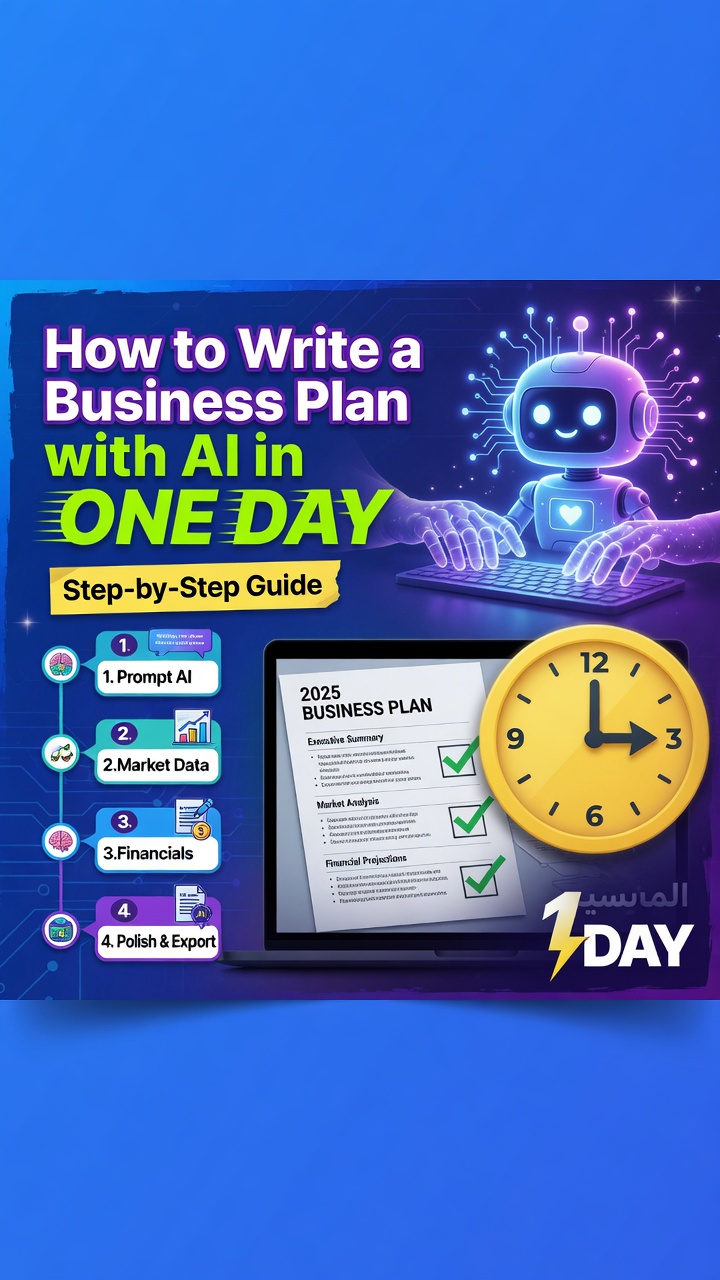
How to Write a Business Plan with AI in One Day (Step-by-Step Guide)
Writing a business plan used to take weeks. Research, financial modeling, competitive analysis, executive summary — each section demanding hours of focused work. In 2026, a disciplined use of AI can compress that timeline to a single productive day without sacrificing quality.
This guide walks through each section of a business plan with the exact AI prompts to use, what to provide, and how to review and polish each output.
What You Need Before You Start
AI can write your business plan, but it can’t invent your business. Before opening ChatGPT or Claude, have these ready:
- A clear description of what your business does and who it serves
- Your target market (geography, demographics, size estimate)
- Your revenue model (how you make money)
- Your competitive landscape (who else exists in this space)
- Basic financial assumptions (expected pricing, startup costs, revenue targets)
- Your background and any key team members
With these inputs, the AI produces specific, usable content. Without them, it produces generic templates.
The 8-Section Business Plan: AI Prompt for Each
Section 1: Executive Summary (Write Last, Do First in Document)
The executive summary goes first in the document but should be written after you have all other sections done. Use this prompt at the end:
Prompt: “You are a business plan consultant. Write a compelling 350-word executive summary for a business with the following profile: [paste your other completed sections or bullet-point overview]. The summary should cover: business description, market opportunity, competitive advantage, business model, financial highlights, and funding ask (if applicable). Make it compelling enough that an investor would want to read the full plan.”
Section 2: Company Description
What to provide: Business name, founding date or planned launch, legal structure, mission statement, location, and what problem you solve.
Prompt: “Write a professional company description section for a business plan. Details: [paste your info]. Include: what the company does, the problem it solves, its mission, legal structure, and founding story. 250–350 words. Professional but not overly corporate tone.”
Section 3: Market Analysis
This is where research matters most. Use Gemini (which has web access) for this section.
Step 1 — Research prompt for Gemini: “Research the market size and growth trends for [your industry] in [target geography] as of 2025–2026. Include: total addressable market size, key growth drivers, major trends, and demographic data about the target customer.”
Step 2 — Writing prompt for ChatGPT/Claude: “Using the following research data: [paste Gemini output], write a market analysis section for a business plan. Include: industry overview, target market definition, market size and growth, customer segments, and key market trends. 400–500 words.”
Section 4: Competitive Analysis
What to provide: Names of 3–5 competitors, their main products/prices, their strengths and weaknesses as you see them.
Prompt: “Write a competitive analysis section for a business plan. My business: [description]. Key competitors: [list with brief notes on each]. Write a professional analysis covering: the competitive landscape, how each competitor positions itself, their key strengths and weaknesses, and how my business differentiates. Include a recommendation for a competitive positioning strategy. 350–450 words.”
Bonus: Ask Claude to generate a competitor comparison table: “Create a competitive comparison table with these competitors: [list]. Columns: Company, Target Customer, Price Point, Key Strength, Key Weakness, Our Advantage vs. Them.”
Section 5: Products and Services
What to provide: Your product/service description, pricing, key features, what makes it better or different.
Prompt: “Write a products and services section for a business plan. Describe the following offering: [your description]. Cover: what it is, how it works, the value it delivers to customers, pricing model, and key differentiators. 300–400 words. Avoid technical jargon — write for a non-expert investor audience.”
Section 6: Marketing and Sales Strategy
What to provide: Your planned marketing channels, sales approach, customer acquisition strategy.
Prompt: “Write a marketing and sales strategy section for a business plan. Business type: [type]. Target customer: [description]. Available budget: [rough figure or ‘limited/bootstrapped’]. Write a realistic 12-month marketing plan covering: target channels, customer acquisition approach, content strategy, sales process, and customer retention. 400–500 words.”
Section 7: Operations Plan
What to provide: How you deliver your product/service, key processes, technology needed, team structure, physical requirements.
Prompt: “Write an operations section for a business plan. Business: [description]. Team: [current or planned]. Key processes: [how you deliver your product or service]. Technology needed: [systems, software, equipment]. Write a clear operations overview covering: daily operations, key processes, team roles, technology stack, and operational requirements. 300–400 words.”
Section 8: Financial Projections
This is the most complex section and where AI helps with structure more than numbers — you need to provide the actual figures.
Step 1: Build basic assumptions in a spreadsheet: Year 1 revenue targets, monthly customers, pricing, key costs (staff, tools, marketing, overhead).
Step 2 — Use this prompt: “Write the financial projections narrative section of a business plan based on these assumptions: [paste your numbers]. Write: a narrative explaining the revenue model, key assumptions, and what drives growth over years 1–3. Then summarize startup costs and funding requirements. 350–450 words. Note clearly that full financial statements are included as appendices.”
Important: AI cannot verify your numbers. Review every figure personally before presenting to investors.
The One-Day Schedule
9:00–10:00am: Gather all your inputs. Fill in the preparation checklist above.
10:00–11:00am: Run Gemini for market research (Section 3). Let it run while you work on other sections.
11:00am–1:00pm: Write Sections 2, 4, and 5 using ChatGPT/Claude. Review and edit each immediately.
1:00–2:00pm: Lunch break (genuinely important — you’re doing real cognitive work reviewing and editing AI output).
2:00–3:30pm: Write Sections 6, 7, and 8. Work on financial model in parallel.
3:30–4:30pm: Write Executive Summary (Section 1) now that you have all sections done.
4:30–5:30pm: Full read-through of the complete document. Edit for consistency, voice, and any gaps. Make sure it sounds like you, not like a template.
End of day: First complete draft ready.
Making It Sound Like You (Not Like AI)
The biggest risk with AI-written business plans is that they all sound the same — competent but generic. To fix this:
Replace generic claims with specific proof. AI might write “our team has extensive experience.” Replace with “our founder spent 7 years leading operations at [Company], managing a $12M budget.”
Add your real story. AI doesn’t know why you started this business. Add 2–3 sentences of genuine origin story in the company description.
Tighten the language. AI tends to over-explain. Cut every sentence that doesn’t add new information.
Check every number. AI sometimes invents plausible-sounding statistics. Verify all data against primary sources.
Tools Summary
| Task | Tool | Cost |
|---|---|---|
| Market research | Gemini (web access) | Free |
| Writing sections | ChatGPT or Claude | Free |
| Competitive table | Claude | Free |
| Financial model | Google Sheets | Free |
| Final polish | Grammarly | Free |
Total cost: $0 for a solid first draft.