
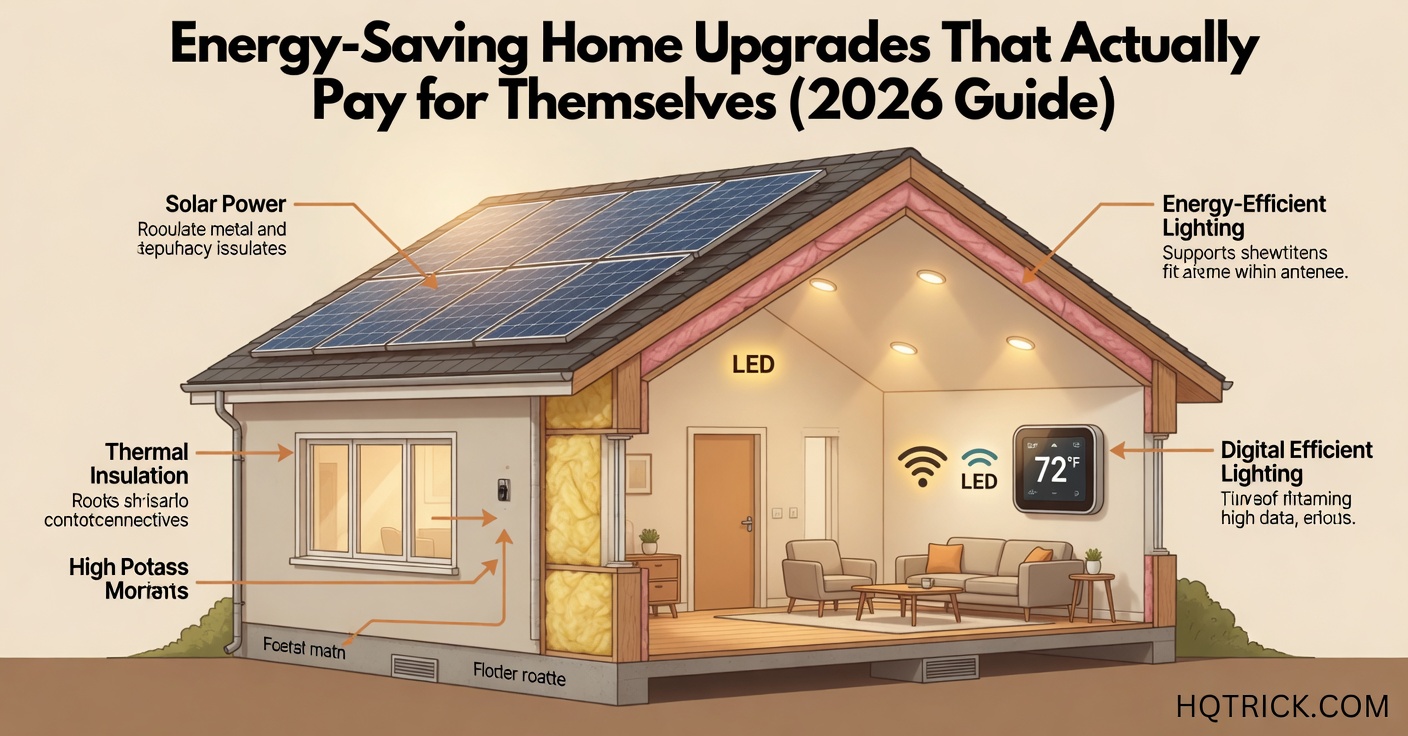
Energy-Saving Home Upgrades That Actually Pay for Themselves (2026 Guide)
Every home improvement purchase is implicitly an investment decision. Most upgrades add value — to your quality of life, to your home’s appearance, or to its resale price. Energy-efficiency upgrades do something different: they generate a direct, measurable financial return through reduced utility bills. Done correctly, they don’t just add value — they pay you back.
This guide focuses exclusively on the upgrades with documented positive ROI: the improvements where the total cost of purchase and installation is recovered through energy savings within a reasonable timeframe. We’ll cover payback periods, current federal and state incentives, and the honest hierarchy of which upgrades to prioritize.
The 2026 Incentive Landscape
Before discussing specific upgrades, it’s worth noting that the Inflation Reduction Act of 2022 created the most significant federal incentive program for residential energy efficiency in decades. Several of these incentives are active through 2032 and meaningfully change the financial calculation for major upgrades.
Key federal credits as of 2026 (consult a tax professional for your specific situation):
Energy Efficient Home Improvement Credit (25C):
- 30% credit on the cost of insulation, windows, doors, air sealing
- Annual caps: $600 for windows, $500 for doors, $1,200 total for most improvements
- 30% credit up to $2,000 for heat pumps and heat pump water heaters
Residential Clean Energy Credit (25D):
- 30% credit on solar panel installation through 2032
- No cap — 30% of total installed cost
These incentives are applied as credits (reducing your tax liability dollar-for-dollar), not deductions. If you owe $3,000 in federal taxes and install a qualifying heat pump with a $2,000 credit, you owe $1,000. Always verify current eligibility at energystar.gov before purchasing.
Priority 1: Attic Insulation
Average cost: $1,500–$4,000 installed; $400–$800 DIY Annual savings: $200–$600 depending on climate and existing insulation level Payback period: 3–8 years (2–5 years with tax credits)
The single highest-ROI energy efficiency upgrade for most homes, particularly those built before 1990. The DOE estimates that upgrading attic insulation to current standards (R-38 to R-60 depending on climate zone) saves 15–25% on annual heating and cooling costs.
The savings are immediate, compound annually with energy price increases, and have no maintenance requirement. The upgrade also improves comfort — rooms that are too hot in summer or too cold in winter despite the thermostat running constantly are almost always insulation problems, not HVAC problems.
Priority 2: Smart Thermostat
Average cost: $60–$250 installed (usually DIY) Annual savings: $100–$180 per year (EPA estimate) Payback period: Under 2 years
The fastest payback of any energy upgrade on this list. Smart thermostats learn your schedule, adjust temperatures automatically when you leave and return, and allow remote control via phone — eliminating the two most common sources of energy waste: heating and cooling an empty home, and forgetting to adjust the temperature when leaving.
The savings estimate is conservative. Households with irregular schedules, those who frequently forget to adjust the thermostat, or those in extreme climates often see savings well above the average.
Priority 3: Air Sealing
Average cost: $200–$600 DIY; $800–$2,500 professional Annual savings: $100–$400 Payback period: 2–6 years
Air sealing addresses the invisible energy loss that happens through gaps around penetrations in your home’s envelope: where plumbing pipes and electrical wires pass through floors and walls, around recessed lights in the attic, at attic hatches, and along the sill plate at the foundation.
The DOE estimates that air sealing combined with insulation reduces heating and cooling costs by up to 20%. A DIY weekend with caulk, spray foam, and weatherstripping applied to the most common leak points costs $50–$150 in materials and delivers meaningful results.
A professional energy audit (often available at reduced or no cost through utility companies) uses a blower door test to identify your home’s specific leak points and prioritizes repairs by impact.
Priority 4: Water Heater Upgrade
Average cost: $1,200–$3,000 installed for heat pump water heater Annual savings: $300–$600 Tax credit: 30% federal credit (up to $2,000) After-credit payback period: 4–7 years
Heat pump water heaters are 2–3 times more efficient than conventional electric resistance water heaters. They work by moving heat from surrounding air into the water (similar to how a refrigerator moves heat out of its interior) rather than generating heat directly.
After the 30% federal tax credit, a heat pump water heater that costs $1,500 installed effectively costs $1,050. Annual savings of $300–$400 produce a payback period of under 4 years — followed by decades of reduced operating costs compared to a standard electric unit.
Priority 5: LED Lighting Conversion
Average cost: $50–$200 total for a full home Annual savings: $150–$400 depending on home size and usage Payback period: Under 1 year
This is the only upgrade on the list that pays back in months rather than years. LED bulbs use 75% less energy than incandescent bulbs and last 15–25 times longer. Replacing all incandescent and CFL bulbs in a typical home costs $80–$150 in materials.
The payback calculation is straightforward: if you have 40 bulbs averaging 4 hours of daily use, the annual energy savings from converting to LED runs $180–$250 depending on your local electricity rate.
Priority 6: Windows and Doors
Average cost: $300–$800 per window installed; $600–$2,500 per door Annual savings: Variable, often modest Tax credit: 30% (up to $600 for windows, $500 per door) Payback period: 15–30 years for windows alone
Windows and doors are the energy efficiency upgrade most often recommended and most often overestimated in terms of financial return. The reality from multiple studies is that window replacement’s primary benefits are comfort (reduced drafts, more even room temperatures) and noise reduction — not primarily energy savings.
The air sealing around windows and doors (weatherstripping and caulking) delivers more energy savings at a fraction of the cost than replacing the units themselves. Start there. Window replacement makes financial sense when your existing windows are single-pane, visibly damaged, or causing significant comfort problems.
Priority 7: Solar Panels
Average cost: $15,000–$30,000 installed before incentives After 30% federal credit: $10,500–$21,000 Annual savings: $1,000–$2,500 depending on system size and electricity rates Payback period: 6–12 years after incentives
Solar economics have improved dramatically over the past decade and are strongest in high-electricity-cost states (California, Hawaii, New England) and high-sun areas (Southwest, Southeast). The 30% federal tax credit, combined with state incentives in many locations, meaningfully accelerates the financial case.
The analysis for solar requires: your current electricity usage and rate, your roof’s orientation and shade situation, available incentives in your state, and whether you own or lease. Use the EnergySage marketplace for quotes and to understand your specific numbers before committing.