
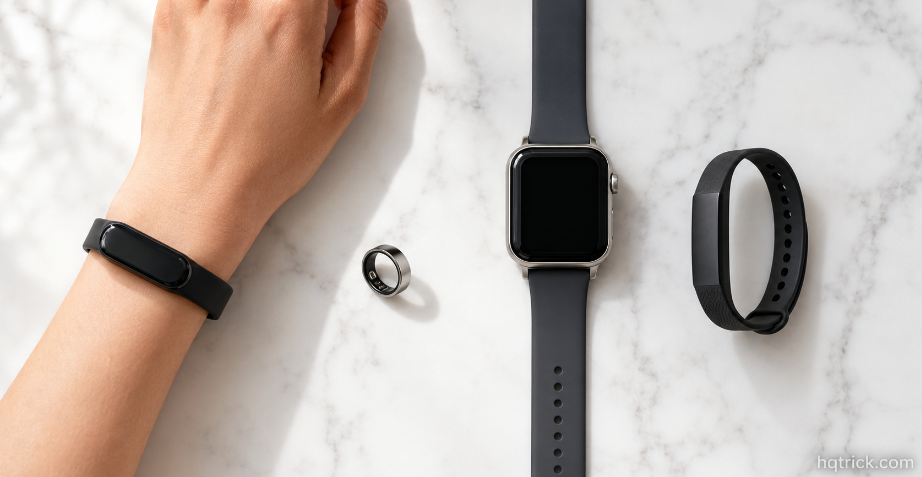
Best Health and Fitness Wearables in 2026 (Ranked by Real Value)
The fitness wearable market has split into two categories in 2026: devices that generate impressive-looking data and devices that generate data that actually changes behavior. The gap between them is larger than most reviews acknowledge.
The honest evaluation criterion isn’t accuracy in a lab setting — it’s whether wearing the device and using the data produces measurable health improvements in the real lives of real people. That’s the lens this guide uses.
What to Actually Use a Fitness Wearable For
Before comparing devices, it’s worth being clear about what wearables are good at and where their limitations are real.
Genuinely useful:
- Sleep stage tracking (trend data, not exact science)
- Resting heart rate trends over weeks and months
- Heart rate variability (HRV) as a recovery and stress indicator
- Step counting and general activity level
- Menstrual cycle tracking (for applicable users)
- Workout heart rate zones
Significant limitations:
- Calorie burn estimates are often 20–40% off from actual expenditure — don’t use them for precise nutrition planning
- Blood oxygen (SpO2) readings on wearables are directional indicators, not medical diagnostics
- Sleep stage data is an estimate, not a clinical measurement
- Stress scores are proprietary algorithms, not standardized medical metrics
The devices below are ranked with these realities in mind.
The 6 Best Fitness Wearables in 2026
1. Oura Ring (Gen 4) — Best for Sleep and Recovery
Price: $349 + $5.99/month subscription Best for: Sleep quality, recovery optimization, people who dislike wrist wearables Battery life: 7–8 days
The Oura Ring has earned its position as the reference standard for sleep tracking among the options available to consumers. Its form factor — a ring rather than a wrist device — keeps it stable during sleep (less movement artifact) and produces sleep stage data that correlates more closely with polysomnography (clinical sleep study results) than most wrist-worn alternatives.
The practical value of Oura comes primarily through the Readiness Score — a daily metric that synthesizes resting heart rate, HRV, body temperature, sleep quality, and activity levels into a single number that functions as a recovery gauge. Most consistent users report that the Readiness Score becomes a reliable signal for whether to push hard in a workout or back off, and many note they’ve learned to notice physical patterns they’d previously ignored.
Limitations: No GPS, no workout tracking, no smartwatch features. It’s a health monitoring device, not an all-purpose fitness computer. The subscription is an ongoing cost that the company has increased; it’s worth factoring into the total cost of ownership.
2. Whoop 5.0 — Best for Athletes and Performance-Focused Users
Price: $239 for 12-month membership (device included) Best for: Athletes, people training seriously, recovery-focused users Battery life: 4–5 days (charges while wearing)
Whoop is the wearable favored by professional athletes, coaches, and fitness-obsessed individuals who want the deepest possible look at recovery and strain. Its differentiation lies in three areas: the Strain score (a measure of cardiovascular load from workouts and daily activity), the Recovery score (HRV, resting heart rate, sleep quality combined), and sleep coaching that gives specific recommendations rather than just data.
The 2026 model added on-body EKG capability and improved HRV accuracy. The subscription model (no upfront device cost) makes it approachable to try but expensive over time.
Whoop is genuinely the right tool for people who are training hard and want to use data to optimize their training load. It’s overkill for casual fitness. The platform rewards people who look at data every day and adjust their behavior accordingly — if that’s not you, another device serves you better.
3. Apple Watch Series 10 — Best All-Around Smartwatch
Price: $399 Best for: Apple ecosystem users, people who want a full smartwatch with health features Battery life: 18 hours (or 3 days in low-power mode)
The Apple Watch remains the most capable smartwatch for most people’s needs, particularly those already in the Apple ecosystem. It does everything competently: notifications, GPS, workout tracking, ECG, blood oxygen, fall detection, crash detection, and integration with Apple Health, which aggregates data from every health app you use.
Its weakness in the context of this comparison is battery life — 18 hours means daily charging, which makes continuous sleep tracking impractical (you’re charging while you sleep or racing through the night with marginal battery). For people who primarily want a daytime activity tracker and smartwatch with health monitoring as a secondary feature, it’s excellent. For people whose priority is sleep and recovery data, it’s limited by the charging constraint.
4. Garmin Fenix 8 — Best for Outdoor and Endurance Athletes
Price: $799–$999 Best for: Runners, cyclists, hikers, triathletes, serious endurance athletes Battery life: Up to 16 days (smartwatch mode)
Garmin is the undisputed leader for GPS-based athletic performance tracking. The Fenix 8’s training intelligence — VO2 max estimates, training load analysis, course navigation, multi-sport transitions — is more sophisticated than anything else available for wrist wear.
For casual users, the Fenix 8 is dramatically more watch than necessary. For anyone training for endurance events or who spends significant time outdoors, it’s the most capable device on this list. The sleep and recovery tracking has also improved substantially in recent Garmin generations and is now competitive with Oura for trend data.
5. Samsung Galaxy Watch 7 — Best for Android Users
Price: $299 Best for: Android users wanting Apple Watch-equivalent features Battery life: 2–3 days
Samsung’s best answer to the Apple Watch in 2026. Body composition analysis (bioelectrical impedance), continuous heart rate, sleep tracking, and integration with Google Health are the highlights. The sleep tracking is solid; the HRV implementation is less comprehensive than Oura or Whoop.
For Android users who want the smartwatch experience with health monitoring features, it’s the clear choice. For health data maximalists, the Oura and Whoop produce more actionable sleep and recovery data.
6. Fitbit Charge 6 — Best Budget Option
Price: $159 Best for: Casual users wanting step counting, basic sleep tracking, heart rate Battery life: 7 days
Fitbit is no longer the innovation leader it once was (Google ownership has been a mixed influence on the product), but the Charge 6 remains the most sensible entry point for someone who wants a fitness tracker without paying $250+. It does the basics competently: steps, active minutes, heart rate, sleep stages, and basic stress tracking through EDA sensors.
For someone who doesn’t currently track anything and wants to start somewhere, the Charge 6 is a reasonable first device. If you find the data motivating and want more depth after six months, the Oura or Whoop are natural upgrades.
The Data-to-Behavior Gap
The best wearable is the one you look at and respond to. A person who checks their Oura readiness score every morning and adjusts their workout intensity accordingly gets dramatically more value from the device than someone who glances at it occasionally.
Before buying, ask yourself: Am I the kind of person who checks dashboards and uses data to make decisions? Or am I more likely to look at a sleep score for a week and then stop caring?
If you’re genuinely data-motivated, the Oura Ring or Whoop produces the most actionable health intelligence per dollar. If you’re more casually interested, the Apple Watch (iPhone users) or Galaxy Watch (Android users) does everything most people actually need at a competitive price.